“I’ve seen that cute ‘Heart Window’ at Shojuin Temple on social media. I want to go, but where exactly is it in Kyoto?” “Are there other things to see besides the window? Is it hard to get there?”
Many people planning a trip to Kyoto likely have these questions.
To give you the conclusion first: Shojuin is one of Kyoto’s leading photogenic spots, featuring the “Window that calls in happiness” and magnificent “Ceiling Art,” all surrounded by beautiful seasonal scenery. It is absolutely worth the trip, even if you have to travel a little further from the city center.
In this article, we will explain the following points you need to know before visiting Shojuin:
- The unique history and characteristics of Shojuin.
- The undeniable charm of the “Inome Window (Heart Window)” and “Ceiling Art.”
- Seasonal ways to enjoy the temple, such as the Wind Chime Festival.
- A clear guide to accessing the temple by car or public transport.
By the time you finish reading, you will have a clear plan to enjoy Shojuin to the fullest. Please read through to the end!
- What is Shojuin? An Ancient Temple with 800 Years of History
- The Symbol of Shojuin: The “Inome Window” (Heart-Shaped Window)
- Breathtaking Beauty! Look Up at the 160 Ceiling Paintings
- Summer Tradition: The “Wind Chime Festival” and Seasonal Events
- Cute Goshuin and Temple Souvenirs
- Thorough Guide to Accessing Shojuin
- Basic Information: Admission, Hours, and Reservations
- Lunch and Sightseeing Spots Around Shojuin
- Summary
- A Message from the Guide
What is Shojuin? An Ancient Temple with 800 Years of History
Located in Ujitawara Town in the southern part of Kyoto Prefecture, Shojuin is a historic temple belonging to the Koyasan Shingon sect of Buddhism. While it has recently become a hot topic among young people and women due to cute photos on social media, its history dates back about 800 years.
History and Origins of Shojuin
Shojuin is said to have been established in the early Kamakura period. The main deity is the “Eleven-faced Kannon,” a hidden Buddha whose doors are opened only once every 50 years, creating a solemn atmosphere. Additionally, the temple houses a “Seated Fudo Myoo” statue, said to be made by the famous Kamakura period sculptor Kaikei, which is designated as a National Important Cultural Property. This Fudo Myoo is unique; despite his powerful expression, he has a somewhat approachable look unlike the typical angry expression.


Blessings for Warding Off Evil and Inviting Fortune
Shojuin has long been worshipped by locals for its ability to ward off evil and invite good fortune. In particular, the “Inome” pattern (discussed later) carries the meaning of removing disasters and bringing in luck, making it a “power spot” for people praying for good relationships and family harmony. Standing in the quiet mountains, the temple grounds are the perfect place to cleanse your mind and gain new energy.

The Charm of Ujitawara Town, the Home of Green Tea
Ujitawara Town, where Shojuin is located, is known as the “Birthplace of Japanese Green Tea.” In the Edo period, Soen Nagatani invented the “Aosei Sencha Method,” which is the current method for processing green tea. On the way to the temple, you can enjoy the peaceful scenery of beautiful tea fields and the scent of tea. When visiting Shojuin, you will receive hospitality in the form of tea and sweets, allowing you to experience the deep flavor of Uji tea.
The Symbol of Shojuin: The “Inome Window” (Heart-Shaped Window)
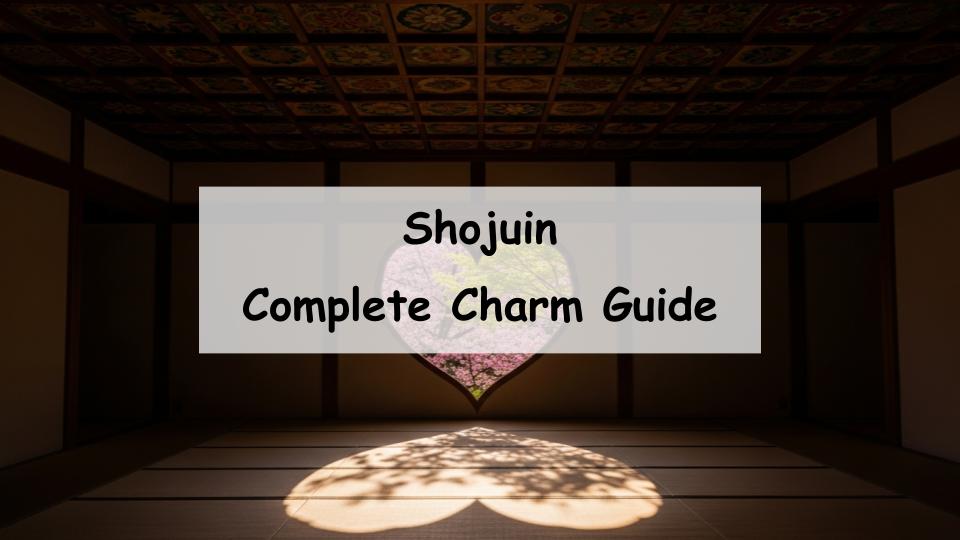
The main attraction for many visitors is the heart-shaped window located in the Guest Hall (Kyakuden). This window is not just cute; it is a special place that condenses Japanese tradition and the beauty of the four seasons.
The Meaning Behind the Traditional “Inome” Pattern
Although it looks like a modern heart symbol, this shape is actually an ancient Japanese traditional pattern called “Inome” (Wild Boar’s Eye). As the name suggests, it is derived from the shape of a boar’s eye. Since the boar is considered the messenger of Atago-sama (a god of fire protection), this pattern has been used in shrine and temple architecture for centuries to prevent fires and ward off evil spirits. In short, this lovely shape contains a powerful prayer to remove misfortune and invite happiness.
Seasonal Scenery: Cherry Blossoms, Fresh Green, Autumn Leaves, and Snow
The greatest charm of the Inome Window is that the scenery viewed through the frame changes dramatically with the seasons. In spring, full-blown cherry blossoms dye the window pink; in summer, vivid fresh greenery brings a sense of vitality. In autumn, fiery red leaves color the window, and in winter, a quiet snowy landscape creates a silver world. No matter when you visit, you will encounter a once-in-a-lifetime view.
The “Shadow of Happiness” at Sunset
There is a miraculous sight that can only be seen when specific conditions are met. When the setting sun shines through the Inome Window, the shape of the window is projected onto the floor as a heart-shaped shadow. This is called the “Shadow of Happiness” or “Blessing of Happiness,” and it is said that seeing it brings good luck. The best time to see this beautiful shadow is around 4:00 PM from late August to mid-September.
Tips for Instagram-Worthy Photos
To take beautiful photos of the Inome Window, try adjusting the position of your camera or smartphone. Instead of standing, shoot from a low angle close to the floor to capture the shape of the window and the scenery outside perfectly. Also, by focusing on the scenery outside the window, the window frame becomes a silhouette, creating a fantastic image. If you visit in a kimono, sitting next to the window and photographing your silhouette is also wonderful.
Breathtaking Beauty! Look Up at the 160 Ceiling Paintings
When you enter the Guest Hall “Sokuten-no-ma,” where the Inome Window is located, your eyes will immediately be drawn to the colorful art covering the entire ceiling.
A Colorful Art Space Depicting Flowers and Japanese Landscapes
The ceiling is paved with 160 square paintings. These were created with the cooperation of many Japanese painters and calligraphers as a project to revive the main hall’s ceiling art. The theme is “Flowers and Japanese Landscapes.” Seasonal flowers such as camellias, cherry blossoms, and hydrangeas, as well as traditional Japanese scenery, are expressed in vivid colors, creating a gorgeous space that feels like being inside a kaleidoscope.

Find the Hidden “Four Guardians” and “Maiko”
Among the 160 paintings, there are some special hidden designs. The “Four Divine Beasts” (Azure Dragon, White Tiger, Vermilion Bird, and Black Tortoise) that protect the four directions are placed in the corners, and there are also four paintings of “Maiko” (apprentice geisha) representing Kyoto. Looking for these specific designs while gazing at the beautiful ceiling art is a fun way to explore Shojuin.
A Luxurious Time Lying Down and Gazing Up
Generally, visitors are expected to sit quietly in temples, but in the Sokuten-no-ma at Shojuin, you are actually allowed to lie down on your back to look at the ceiling paintings. Lying on the tatami mats and looking up at the beautiful art filling your field of vision offers a luxurious time that washes away stress. However, when it is crowded, please be considerate of others and share the space.

Summer Tradition: The “Wind Chime Festival” and Seasonal Events
Shojuin is also known as the “Wind Chime Temple” (Furin-ji), and its summer Wind Chime Festival is famous. However, the charm is not limited to summer. Events that show different expressions each season are also not to be missed.
Highlights of the “Wind Chime Festival” with Over 2,000 Chimes
Held annually from roughly June to September, the “Furin Matsuri” features over 2,000 wind chimes decorating the temple grounds. Ujitawara Town is a summer resort area where the temperature is about 5 degrees Celsius lower than in Kyoto City. Combined with the cool sound of the wind chimes, you can feel the coolness with all five senses. During the period, “Flower Wind Chimes” featuring seasonal flowers like hydrangeas, sunflowers, and cosmos inside the chimes appear, making for excellent photos. There is also an area exhibiting local wind chimes from all 47 prefectures of Japan, where you can enjoy the differences in sound and shape.
Limited-Time Light-Ups and Night Viewing
During the Wind Chime Festival or the autumn foliage season, light-ups and night viewings may be held for a limited time. The atmosphere is completely different from the bright and refreshing daytime; the Inome Window and wind chimes floating in the dark night radiate a fantastic and mysterious beauty. Since these special viewings often require advance reservations, we recommend checking the official website before visiting.

Don’t Miss Spring Cherry Blossoms and Autumn Leaves
The grounds of Shojuin are known as a famous spot for cherry blossoms in spring and autumn leaves in the fall. In particular, the spring cherry blossoms are magnificent not only when viewed through the Inome Window but also blooming around the Jizo Hall on the grounds. In autumn, the surrounding mountains turn colorful, making it a perfect season for a drive.
Cute Goshuin and Temple Souvenirs
The Goshuin (temple stamps) and souvenirs you can receive as proof of your visit are full of Shojuin’s unique creativity and cuteness.
Limited Goshuin Changing by Season and Month
Shojuin’s Goshuin are popular for their variety and high design quality. In addition to the standard Goshuin of the main deity “Eleven-faced Kannon” and “Fudo Myoo,” there are monthly limited Goshuin featuring seasonal flowers and events. Some are designed as a two-page spread, looking like a piece of art that adds color to your Goshuin book.
The “Kanou-himo” Knot: Proof of Worship
When you pay the admission fee, you will receive a cute braided cord along with a pamphlet. This is called “Kanou-himo” (Granting Cord). The knot forms the shape of the kanji characters for “Mouth” (口) and “Ten” (十), which combine to form the character for “Grant/Fulfill” (叶). It is considered a lucky charm that grants wishes. You can take it home as a charm, but many visitors tie it to the Jizo Hall in the precincts with a wish. The sight of many colorful cords tied together is a photo spot in itself.
Popular Amulets and Original Goods
At the reception, “Heart Amulets” with the Inome Window motif and original Goshuin books designed with seasonal scenery are available. They also offer a “Bracelet Rosary Making” experience using birthstones, allowing you to get a special souvenir unique to you.

Thorough Guide to Accessing Shojuin
While Shojuin is full of charm, access requires some attention. Since it is located in a mountainous area, careful planning is essential when using public transportation.
Using Public Transport (Train, Bus, Taxi)
If going by train, the nearest stations are JR Nara Line “Uji Station,” Keihan Uji Line “Uji Station,” or Kintetsu Kyoto Line “Shin-Tanabe Station.” From any of these stations, you will need to transfer to a bus or taxi.
Route Details from JR Uji Station / Kintetsu Shin-Tanabe Station
On weekends and holidays, the “Uji Tea Bus” is the most convenient option. It runs from JR Uji Station and Keihan Uji Station and takes you directly to the “Shojuin-guchi” bus stop without transfers. From there, it is about a 10-minute walk to the temple.
On weekdays, there is no direct bus. You must take a Keihan Bus to the “Ichu-mae” stop, and then transfer to a taxi or a community bus.
Tips for Buses and Recommending Taxis
The community bus used on weekdays runs very infrequently and has limited capacity, so it can be difficult for tourists to use. Therefore, on weekdays, it is realistic and smooth to take a taxi from the “Ichu-mae” bus stop. If you are in a group, taking a taxi directly from the train station or booking a “Shojuin Direct Plan” offered by taxi companies (like MK Taxi) is a smart choice.
Using a Car and Parking Information
If using a private car or rental car, access is from the Keiji Bypass “Uji-Nishi IC” or the Shin-Meishin Expressway “Shigaraki IC.” Since the route involves mountain roads, some parts are narrow, so please drive with caution.
Moving from the Parking Lot to the Grounds
Shojuin has parking lots for worshippers (Parking Lot 1 & 2). A cooperation fee of about 300 yen is requested. The walk from the parking lot to the temple grounds is short. However, during busy times like the Wind Chime Festival, it may be crowded. In such cases, please follow the staff’s instructions to use temporary parking lots if necessary.
Basic Information: Admission, Hours, and Reservations
Here is the basic information you should check before visiting.
Visiting Hours and Admission Fee
Normal visiting hours are 9:00 – 16:30 during summer (April – October) and 9:00 – 16:00 during winter (November – March). The admission fee is 1000 yen for adults (subject to change during the Wind Chime Festival), which includes tea, a sweet, and the Kanou-himo cord.
Tea and Sweet Hospitality (Guest Hall Sokuten-no-ma)
The tea and sweets included in the admission fee are served in the Guest Hall “Sokuten-no-ma.” Tasting Ujitawara tea and simple sweets while gazing at the beautiful ceiling art and Inome Window is a blissful moment to heal your travel fatigue.
When Advance Reservations Are Required
Basically, reservations are not required for individual visits. However, reservations are necessary for group visits or participation in special events (such as private light-ups or yoga experiences). Also, in the past, reservations were required during specific periods to alleviate congestion. If you plan to visit during peak times like the Wind Chime Festival or Golden Week, we recommend checking the latest information on the official website or social media.
Lunch and Sightseeing Spots Around Shojuin
Since you have come all the way to Ujitawara Town, enjoy the surrounding spots as well.
Lunch at Ujitawara Tea Gourmet Spots and Cafes
There are cafes and restaurants scattered around Shojuin that are unique to the tea-producing region. You can enjoy matcha sweets at cafes renovated from old folk houses or taste fragrant tea soba noodles. There are also shops serving lunch using plenty of local vegetables, allowing you to enjoy a leisurely countryside time. Since the number of shops is limited, it is safe to research lunch spots in advance.
Nearby Sightseeing Spots to Visit Together
For those interested in the history of tea, visiting the “Birthplace of Soen Nagatani” is recommended. This is where the ancestor of Japanese green tea, Soen Nagatani, lived, and tea-making tools are on display. It is also good to extend your trip slightly to visit “Sarumaru Shrine.” This shrine is dedicated to Sarumaru no Taifu, who appears in the Hyakunin Isshu (100 Poems), and is known as a god who cures lumps/tumors.
Summary
Shojuin is a wonderful temple that combines the history of an 800-year-old ancient temple with beauty that resonates with modern sensibilities, such as the heart-shaped “Inome Window” and colorful “Ceiling Art.” The changing nature of the four seasons, the cool sound of wind chimes, and the hospitality of Uji tea will make you forget the hustle and bustle of everyday life.
Access requires a little planning, but the emotion when you arrive is worth it. Please use the points introduced in this article as a reference and spend a special, heart-fluttering time at Shojuin.
A Message from the Guide
It is undeniable that the temple focuses heavily on being ‘Instagrammable,’ so I recommend it to those who can accept that for what it is and enjoy the experience.



Comment