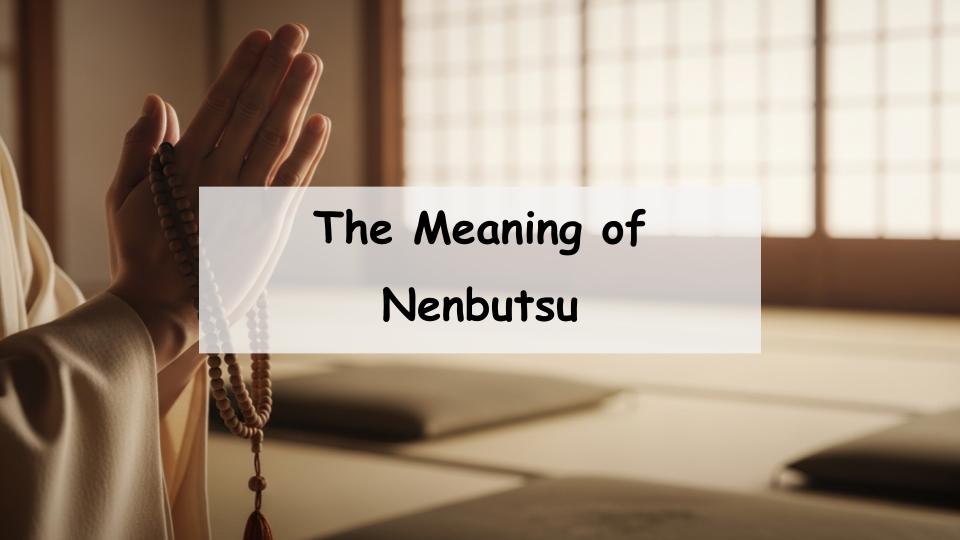
You often hear “Nenbutsu” at Buddhist memorial services and funerals in Japan, but have you ever wondered what it actually means?
“I know the phrase ‘Namu Amida Butsu,’ but I don’t really know why we chant it.”
“Are there differences in how it is chanted or understood depending on the sect?”
Many people wish to know more about Nenbutsu but aren’t sure who to ask.
To give you the conclusion first: Nenbutsu is the act of keeping the Buddha’s image and virtues in mind or chanting the Buddha’s name aloud. Generally, it refers to the “Recitative Nenbutsu” (Shomyo Nenbutsu) where one chants “Namu Amida Butsu,” but the purpose and etiquette can differ significantly depending on the Buddhist sect.
In this article, we will explain the following points in detail:
- The true meaning and history of Nenbutsu
- Differences in philosophy between sects like Jodo Shu and Jodo Shinshu
- 3 steps to correctly understand and practice Nenbutsu
By reading this article, your questions about Nenbutsu will be resolved, allowing you to put your hands together in prayer with a deeper sense of understanding.
What is “Nenbutsu” in the First Place? Meaning and Origin
The word “Nenbutsu” holds a very important place in Buddhism. While it is generally known as chanting “Namu Amida Butsu” aloud, it has a deep meaning and a long history. Let’s first unravel the origin of the words and their true meaning.
Breaking Down the Meaning of “Namu Amida Butsu”
The six-character phrase “Namu Amida Butsu” (南無阿弥陀仏) that we hear originates from Sanskrit, the ancient language of India. By dividing this phrase into two parts—”Namu” and “Amida Butsu”—we can better understand its true significance.
The Meaning of “Namu”
“Namu” is a transliteration of the Sanskrit word “Namas.” In English, it means “to take refuge.” Taking refuge is an expression of strong respect and trust, meaning to entrust your body and mind completely and to follow with faith. In other words, chanting “Namu” is a declaration to the Buddha: “I trust you from the bottom of my heart and leave everything to you.”
The Meaning of “Amida Butsu”
“Amida Butsu” is the name of a Buddha derived from the Sanskrit words “Amitabha” (Infinite Light) and “Amitayus” (Infinite Life). It signifies a Buddha who illuminates people with infinite light that knows no spatial boundaries and saves everyone with infinite life that knows no temporal boundaries. Therefore, the full phrase “Namu Amida Butsu” means, “I take refuge in and entrust myself to Amida Buddha, who possesses infinite light and life.”
Two Types of Nenbutsu: “Recitation” and “Contemplation”
There are broadly two ways to practice Nenbutsu. One is “Shomyo Nenbutsu” (Recitative Nenbutsu), which is mainstream today and involves chanting the Buddha’s name aloud. The other is “Kanso Nenbutsu” (Contemplative Nenbutsu), which involves visualizing the Buddha’s appearance and the Pure Land in detail within one’s mind. Originally, early Buddhism practiced contemplative Nenbutsu, which required intense focus. However, because this was a highly advanced practice that not everyone could perform, Recitative Nenbutsu—simply chanting with the mouth—gradually spread as a more accessible path.
History and Spread of Nenbutsu in Japan
The history of Nenbutsu in Japan is long. In the Heian period, it was practiced as a form of ascetic training by monks of the Tendai sect. By the mid-Heian period, Kuya Shonin took Nenbutsu to the streets to spread it among the common people, earning him the title “Saint of the Marketplace.” In the Kamakura period, figures like Honen Shonin and Shinran Shonin appeared, teaching Nenbutsu as a path to salvation even for commoners who could not undergo strict ascetic training. This led to its explosive spread throughout Japan.


[By Sect] Differences in Thinking and Chanting
Although the phrase “Namu Amida Butsu” is the same, the interpretation and purpose of chanting vary clearly by sect. The differences are particularly notable between Jodo Shu and Jodo Shinshu, two major forces in Japanese Buddhism. Let’s look at how each sect positions Nenbutsu.
Jodo Shu: Nenbutsu as Practice for Rebirth in the Pure Land
In Jodo Shu, founded by Honen Shonin, Nenbutsu is viewed as a “practice to attain Ojo (rebirth in the Pure Land).” Believing in Amida Buddha’s vow that “those who call my name will surely be saved,” followers chant “Namu Amida Butsu” earnestly to be welcomed into the Pure Land after death. In Jodo Shu, Nenbutsu is seen as an effort or practice one performs to go to the Pure Land, so the frequency and continuity of chanting tend to be emphasized.
Jodo Shinshu: Nenbutsu as “Gratitude” for Salvation
In Jodo Shinshu, founded by Shinran Shonin, the meaning of Nenbutsu is quite different. Jodo Shinshu teaches that the moment you feel the urge to chant “Namu Amida Butsu,” Amida Buddha’s salvation is already accomplished. Therefore, Nenbutsu is not a means to “get saved by chanting,” but rather something chanted out of “gratitude for already being saved.” This is called the “Nenbutsu of Gratitude.” It emphasizes “Tariki” (Other Power—entrusting oneself to Amida’s power) rather than “Jiriki” (Self Power or ascetic practice).
Features of Ji Shu, Tendai, and Yuzu Nembutsu Shu
Nenbutsu is inherited in unique ways in other sects as well.
- Ji Shu: Founded by Ippen Shonin, this sect is known for the “Dancing Nenbutsu,” where followers beat drums and bells while chanting, aiming to become one with the Buddha in a state of ecstasy.
- Tendai Shu: Nenbutsu is incorporated as part of meditation and training. There is a rigorous practice called “Jogyo Zanmai,” where monks walk and chant Nenbutsu continuously for 90 days.
- Yuzu Nembutsu Shu: This sect emphasizes interconnectedness, teaching that one person’s Nenbutsu becomes merit for all, and the Nenbutsu of all becomes merit for oneself.
Do Zen and Nichiren Sects Chant Nenbutsu?
Generally, Zen sects (like Soto Shu and Rinzai Shu) and the Nichiren sect do not chant “Namu Amida Butsu.”
Zen sects focus on realizing the “Buddha nature” within oneself through Zazen (seated meditation), so they do not seek salvation from an external Amida Buddha.
The Nichiren sect chants the Daimoku, “Namu Myoho Renge Kyo,” as their central practice.
While the scriptures relied upon and the goals of practice differ, the spiritual attitude of “Namu” (taking refuge) is common across all Buddhism.



3 Steps to Correctly Understand and Practice Nenbutsu
Once you understand the meaning of Nenbutsu and the differences between sects, how should you incorporate it into your life? Here are three steps that even beginners can easily practice.
Step 1: Trust in the Buddha’s Salvation and Turn Your Heart
The first step is to settle your mind, rather than just focusing on the form. Facing a Buddhist altar or an image of the Buddha, turn your thoughts to the great compassion of Amida Buddha, who wishes to save everyone. Even if you don’t understand the detailed doctrines of the sect, it is important to face the practice with an honest heart, believing that “there is a presence watching over me.” This mental preparation changes Nenbutsu from a mere list of words into a meaningful act.
Step 2: Learn Basic Etiquette like Holding Prayer Beads and Posture
Next, organize your physical form. Straighten your posture and sit or stand in front of the altar. The way to hold Juzu (prayer beads) varies by sect, but generally, you pass them through your left hand or hang them between the thumb and index finger of both hands clasped together. When doing Gassho (clasping hands), press your fingers together firmly and tilt them slightly upward in front of your chest. Straightening your spine and regulating your breathing will naturally calm your mind.
Step 3: Chant Aloud and Settle Your Mind in Daily Life
Finally, actually chant “Namu Amida Butsu” aloud. The volume does not matter, but chanting at a level where you can hear your own voice helps you concentrate. It is recommended to make this a daily routine, such as when you wake up, before you go to sleep, or when you put your hands together at the altar. By making it a habit, you can secure a quiet time to reflect on yourself amidst the busyness of daily life.
3 Merits and Effects Gained by Chanting Nenbutsu
Chanting Nenbutsu brings many positive influences to our minds, beyond just religious significance. Here, we explain the merits (benefits) handed down from ancient times and the effects seen from a modern perspective.
Memorial for the Deceased and a Peaceful Send-off
The most familiar effect is the memorial for the deceased. Chanting Nenbutsu at funerals and memorial services is an act of praying that the deceased will be safely guided to the Pure Land by Amida Buddha. Also, for those left behind, facing the deceased through Nenbutsu helps in overcoming the sadness of parting and organizing one’s feelings. Praying for the peace of the deceased leads to the peace of one’s own mind.
Erasing Sins and Promising Rebirth in the Pure Land
In Buddhist teachings, Nenbutsu is said to have the power to cleanse past sins and impurities. As long as humans are alive, we unknowingly commit sins or suffer from worldly desires. However, it is taught that by chanting Nenbutsu while illuminated by Amida’s light, this karma is purified. Ultimately, one gains the assurance that they can be reborn in the Pure Land, free from suffering, after death.
Alleviating Anxiety and Suffering, Gaining Mental Stability
In modern society, chanting Nenbutsu also plays a role similar to a mental stabilizer. The act of repeatedly vocalizing “Namu Amida Butsu” with a steady rhythm is said to activate serotonin nerves in the brain and have a relaxing effect. when you feel anxiety about the future or daily stress, chanting Nenbutsu creates a sense of “being protected by a greater existence,” alleviating loneliness and fear.
Summary
Nenbutsu is the act of taking refuge in and entrusting everything to Amida Buddha, who possesses infinite light and life, through the phrase “Namu Amida Butsu.” The method of practice varies by sect, such as Jodo Shu viewing it as “practice for rebirth” and Jodo Shinshu viewing it as “gratitude for salvation.”
However, regardless of the sect, the basics remain the same: trusting the Buddha, straightening your posture, and chanting aloud. Chanting Nenbutsu in daily life not only honors the deceased but also releases our own minds from guilt and anxiety, providing spiritual peace. Why not take this opportunity to quiet your heart, put your hands together, and try chanting Nenbutsu?
A Message from the Guide
When you put your hands together at a temple, make sure to chant earnestly in your heart.



Comment