In Japan, there is a famous proverb: “If three people gather, they have the wisdom of Monju (Manjushri).”
Manjushri Bodhisattva, known in Japan as Monju Bosatsu, is widely beloved as the Buddhist deity of academic success. Students and their families frequently visit temples dedicated to him to pray for passing entrance exams.
However, you might wonder:
“Who exactly is Manjushri Bodhisattva?”
“Why is he considered the symbol of wisdom?”
“Does he offer blessings other than academic success?”
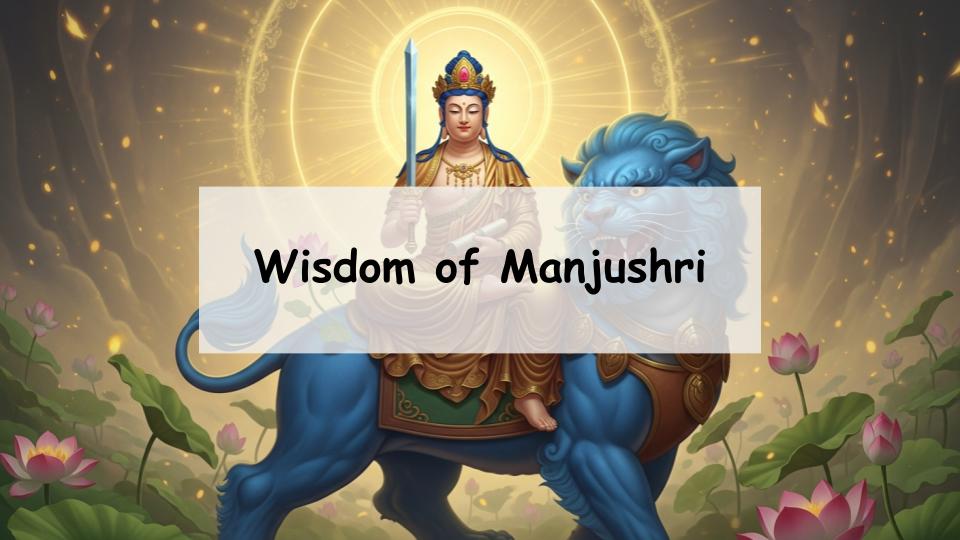
Many people are unaware of the detailed origins and deep meanings behind this figure. To state the conclusion first, Manjushri is not merely a god who helps you study better. He is a highly ranked Bodhisattva who governs “Root Wisdom (Prajna),” the fundamental insight that cuts through delusion and leads to enlightenment. Represented as the attendant on the left of Shakyamuni Buddha and riding a lion, his appearance holds profound Buddhist teachings.
In this article, we will explain Manjushri Bodhisattva in detail, focusing on the following points:
The meaning of his name and his historical origins.
Why he rides a “lion” and holds a “sword.”
The truth about his blessings beyond just academic success.
Faith in Manjushri in Japan and famous temples.
By reading this article, you will correctly understand the true nature of Manjushri Bodhisattva, which will deepen your thoughts and feelings when you visit temples or join your hands in prayer.
- What is Manjushri Bodhisattva? Basic Knowledge of the Buddha of Wisdom
- Blessings and Faith of Manjushri Bodhisattva
- Characteristics and How to Identify Him | Decoding the Statue’s Appearance
- Position in the Shakyamuni Triad
- Mantra and Sanskrit Character of Manjushri
- The Three Great Manjushri Temples of Japan and Recommended Spots
- A Message from the Guide
What is Manjushri Bodhisattva? Basic Knowledge of the Buddha of Wisdom
There are countless Buddhas in the world of Buddhism, but among them, Manjushri Bodhisattva has gathered deep faith since ancient times as the figure symbolizing “Wisdom.” First, let us unravel the basic knowledge of what role he plays and where he comes from.
The Role and Meaning Symbolizing “Wisdom”
The greatest characteristic of Manjushri Bodhisattva is that he governs “Wisdom” in Buddhism. The wisdom referred to here does not simply mean being smart or having abundant knowledge. It refers to the power of enlightenment to discern the truth of things and cut off the roots of hesitation and suffering. In Buddhist terminology, this is also called “Prajna.” Manjushri possesses wisdom so excellent that he is called the teacher of all Buddhas, and he plays the role of a guide who leads practitioners to true enlightenment.
Origin of Manjushri | Theory of a Real Historical Figure
While many Bodhisattvas are mythical beings, there is a strong theory that Manjushri Bodhisattva was modeled after a real person who lived in ancient India. It is believed that a high-ranking monk who worked hard to compile scriptures to correctly transmit the teachings after the death of Shakyamuni Buddha is the origin of Manjushri. His achievements as a real person became legendary, and over time he was deified as the “Buddha of Wisdom.” This human background may be one of the reasons why people feel Manjushri is a relatable presence.

Meaning of the Sanskrit “Manjushri”
The name Manjushri comes from the Sanskrit word “Manjusri,” which was transliterated into Japanese as “Monjushiri.” The word Manjushri contains meanings such as “Gentle Glory” or “Wonderful Auspiciousness.” From this, he is sometimes called “Myokissho Bosatsu” (Bodhisattva of Wonderful Auspiciousness). As the name suggests, Manjushri is often depicted in a beautiful and noble form, worshipped as a precious being who brings good fortune along with the brilliance of wisdom.
Blessings and Faith of Manjushri Bodhisattva
Because Manjushri is the Buddha of Wisdom, it is believed that he offers various blessings related to intellectual activities. However, faith in him goes beyond merely being a god of study. Let us delve deeper into the relationship between Manjushri and our daily lives, including proverbs rooted in culture and beliefs based on birth years.
Academic Achievement and Success in Exams
In modern Japan, the most common faith directed toward Manjushri Bodhisattva is for academic achievement and success in exams. When the entrance exam season arrives, temples enshrining Manjushri are bustling with many students and their families. This is because it is believed that the wisdom granted by Manjushri does not only provide knowledge to solve test problems but also enhances calm judgment and memory to demonstrate one’s true ability during the actual event. He also serves as a reassuring guardian for working adults who wish to master new skills or knowledge.

The True Meaning of the Proverb “Three Gathered possess the Wisdom of Manjushri”
The proverb “Three gathered possess the wisdom of Manjushri” (Sannin yoreba Monju no chie) is something everyone in Japan has heard at least once. It corresponds to the English saying “Two heads are better than one.” It means that even if individuals are ordinary, if three people gather and consult with one another, excellent wisdom comparable to that of Manjushri will emerge. This saying preaches the importance of not being self-righteous but cooperating to share ideas. At the same time, the fact that this proverb is so established proves how widely Manjushri is recognized as the synonym for “Supreme Wisdom.”
Role as Guardian Deity for the Year of the Rabbit
In Buddhism, there is a concept of “Guardian Deities” assigned to the Chinese zodiac sign of one’s birth year. Manjushri Bodhisattva is the guardian deity for those born in the Year of the Rabbit. It is said that people born in the Year of the Rabbit are protected from disasters and can live a peaceful life by cherishing their faith in Manjushri. Of course, he is a precious Buddha for those born in other years as well, but for those born in the Year of the Rabbit, he is a special partner who watches over them throughout their lives.
Characteristics and How to Identify Him | Decoding the Statue’s Appearance
There are several points to identify Manjushri Bodhisattva when viewing Buddhist statues. His appearance is not merely decorative; deep religious meanings are embedded in every detail. Here, we will explain the characteristic elements of Manjushri statues: his mount, the items he holds, and his hairstyle.
Why Ride a Lion?
The most distinctive feature of Manjushri Bodhisattva statues is that he rides a lion, the king of beasts. Riding a ferocious lion, rather than a gentle herbivore, indicates that the power of Manjushri’s wisdom is overwhelmingly strong. Just as a lion’s roar frightens all other beasts, Manjushri’s wisdom has the power to crush all hesitation and worldly desires, vigorously awakening the mind. This appearance symbolizes that wisdom is not static but a dynamic force that changes the world.
What the Right Hand’s Sword and Left Hand’s Scroll Represent
Many statues of Manjushri hold a sword in the right hand and a scroll of sutras in the left. The sword in the right hand is called the “Sword of Wisdom,” signifying the sharp cutting away of ignorance and worldly desires nesting in people’s hearts. It is not a sword for military force, but a symbol for severing mental hesitation. Meanwhile, the scroll in the left hand is generally considered to be the “Prajna Sutra,” in which the Buddha’s teachings and truth itself are written. It is a form that embodies the function of wisdom: cutting off hesitation with the sword and showing the correct truth with the scriptures.
Differences in Hairstyle (Five Knots, etc.)
Manjushri Bodhisattva statues have distinctive hairstyles. The most representative is the style called “Gokei” (Five Knots), where the hair is tied into five bunches on top of the head. This represents the Five Wisdoms and is also said to mimic the hairstyle of a child. There are other variations, such as the Single-Knot Manjushri or the Eight-Knot Manjushri, which have different names and meanings depending on the number of knots. Paying attention to these differences provides clues to understanding the intention behind the creation of the statue.
What is Chigo Monju?
Sometimes Manjushri Bodhisattva is depicted in the form of a child; this is called “Chigo Monju.” Taking the appearance of an innocent child symbolizes that the Buddha’s wisdom is pure and untainted. Furthermore, in biographies of high monks, episodes frequently appear where Manjushri appears in the form of a child to admonish the pride of practitioners or test their faith. Being able to take a familiar, childlike form in addition to a strict one is one of Manjushri’s great charms.
Position in the Shakyamuni Triad
In the “Shakyamuni Triad” statues often seen in the main halls of temples, Manjushri Bodhisattva occupies an important position. By understanding his role as part of a team centered on Shakyamuni Buddha, rather than just worshipping him alone, the worldview of Buddhism becomes clearer.
Role as an Attendant Supporting Shakyamuni Nyorai
A Shakyamuni Triad is a format in which Shakyamuni Nyorai (Buddha) is in the center, with two Bodhisattvas placed on his left and right. In this arrangement, Manjushri Bodhisattva is usually placed to the left of Shakyamuni (the right side from the viewer’s perspective). This is called the “Left Attendant,” and he plays the role of supporting the wisdom aspect of Shakyamuni. He can be described as an important aide who supports the teachings of his master, Shakyamuni, theoretically and rationally.
Difference from Samantabhadra (Fugen) | Contrast of “Compassion” and “Wisdom”
Serving as the Right Attendant of Shakyamuni (the left side from the viewer’s perspective) is Samantabhadra Bodhisattva (Fugen Bosatsu), who rides an elephant. While Manjushri symbolizes “Wisdom,” Samantabhadra symbolizes “Compassion” and “Practice” (Action). Wisdom (theory) alone can become overly intellectual, while Compassion (practice) alone can become blind. The presence of both Manjushri and Samantabhadra expresses that the teachings of Shakyamuni become complete when theory and practice, wisdom and compassion, are in harmony.
Mantra and Sanskrit Character of Manjushri
In temples influenced by Esoteric Buddhism, prayers are offered to Manjushri using Mantras and Sanskrit characters (Bonji). It is believed that the power of the Buddha is condensed in these words and letters.
Meaning and Effect of the Mantra “Om Ara Ha Sha Nou”
The most widely known mantra of Manjushri Bodhisattva is “Om Ara Ha Sha Nou.” It is said that chanting this phrase brings the merit of quickening the mind, increasing memory, and obtaining wisdom. Before studying for exams or when forced to make important decisions, it is believed that calming your mind and chanting this mantra allows you to connect with the wisdom of Manjushri.
The Sanskrit Character “Mam”
Buddhas are sometimes represented by a single Sanskrit character (Bonji); the character representing Manjushri Bodhisattva is “Mam.” This character itself is regarded as Manjushri, and it is often written on amulets and Goshuin (temple stamps). It is said that people born in the Year of the Rabbit can receive stronger protection from their guardian deity by wearing or carrying this character “Mam.”
The Three Great Manjushri Temples of Japan and Recommended Spots
There are numerous temples in Japan that enshrine Manjushri Bodhisattva, but among them, the temples known as the “Three Great Manjushri Temples of Japan” (Nihon Sandai Monju) are particularly distinguished and gather much faith. If you wish for academic success, these are sacred places you should visit at least once.
What are the Three Great Manjushri Temples?
The Three Great Manjushri Temples generally refer to Abe Monju-in in Nara Prefecture, Chion-ji (Kireto Monju) in Kyoto Prefecture, and Daishōji (Kameoka Monju) in Yamagata Prefecture. All of them have a long history, and during the entrance exam season, visitors from all over the country come to worship. We will briefly introduce each temple.
Abe Monju-in (Nara Prefecture)
Abe Monju-in, located in Sakurai City, Nara Prefecture, is known as the oldest Manjushri sacred site in Japan. The principal image is a National Treasure created by the sculptor Kaikei, and it is the largest Manjushri statue in Japan, reaching 7 meters in height. It is also famous as a temple associated with the Yin-Yang master Abe no Seimei, and one can expect blessings for warding off evil and directional protection.
Chion-ji / Kireto Monju (Kyoto Prefecture)
Located in Miyazu City, Kyoto Prefecture, near Amanohashidate (one of the Three Views of Japan), Chion-ji is affectionately known as “Kireto no Monju.” It is said to be the birthplace of the legend “Three gathered possess the wisdom of Manjushri.” Along with the beautiful scenery facing the sea, it has gathered the faith of people since ancient times.
Daishōji / Kameoka Monju (Yamagata Prefecture)
Daishōji, located in Takahata Town, Yamagata Prefecture, is known by the name “Kameoka Monju.” It is the center of Manjushri faith in the Tohoku region, and many students visit to pray for success during the entrance exam period. The sight of people joining their hands in prayer amidst the severe winter cold makes one feel the history of the place as a site of earnest prayer.
Other Famous Temples
Besides the Three Great Manjushri Temples, there are famous temples enshrining Manjushri in various places. For example, Chikurin-ji in Kochi Prefecture is said to have been established in association with Mount Wutai in China (a sacred site for Manjushri) and is visited by endless pilgrims as one of the temples on the Shikoku Pilgrimage. Also, in many Zen temples, Manjushri is enshrined as the Holy Monk in the meditation hall or dining hall, encouraging a correct life based on wisdom. Opportunities to meet Manjushri Bodhisattva at nearby temples are surprisingly common, so please try to look for him.
A Message from the Guide
Join your hands in prayer to Manjushri Bodhisattva and attain the ultimate wisdom.


Comment