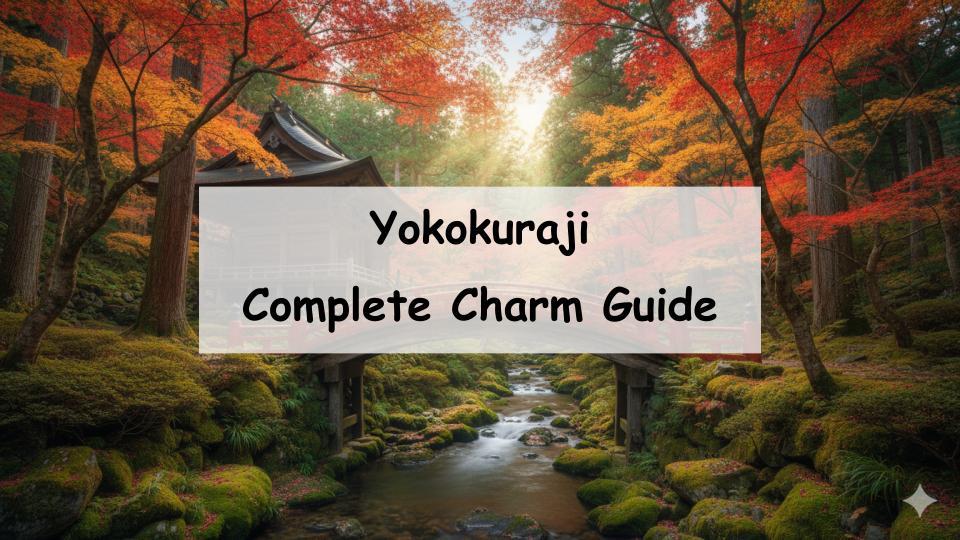
Have you heard of “Yokokura-ji” (Yokokura Temple), an ancient temple nestled deep in the mountains of Ibigawa Town, Gifu Prefecture?
Known as the “Shosoin of Mino” (referencing the famous treasure house in Nara), this temple is renowned for housing numerous valuable cultural assets and, most notably, one of Japan’s rare “Sokushinbutsu” (self-mummified monks).
However, travelers planning a visit often have questions such as:
- “What exactly are the highlights of Yokokura-ji?”
- “Can I see the mummified monk at any time?”
- “I heard the autumn leaves are beautiful, but when is the best time to go?”
- “It seems to be deep in the mountains; how do I get there?”
To give you the short answer: Yokokura-ji is a destination well worth the journey, offering historically significant Buddhist statues, a mysterious mummy, and stunning seasonal nature. The autumn foliage season, in particular, features a magical light-up event that creates a breathtaking atmosphere.
In this article, we will provide a detailed guide for anyone considering a visit to Yokokura-ji, covering:
- The history of Yokokura-ji and why it is called the “Shosoin of Mino”
- Must-see highlights, including the Sokushinbutsu (Myoshin Hoshi)
- The charm of the four seasons, especially the autumn leaves
- Access methods via car and public transport
By reading this guide, you will fully understand the appeal of Yokokura-ji and be able to plan your trip smoothly. Please read on to discover this mysterious space where history and nature weave together.
- What is Yokokura-ji (Ryokai-zan Yokokura-ji)?
- The Main Highlights: The Mummy and Buddhist Statues
- Strolling the Grounds: Spots to Feel History
- A Famous Spot for Autumn Leaves & Seasonal Scenery
- Basic Information (Hours, Fees, Goshuin)
- Access: How to Get There
- Nearby Sightseeing Spots
- Summary: Touch History and Mystery at Gifu’s Hidden Gem, Yokokura-ji
- A Message from the Guide
What is Yokokura-ji (Ryokai-zan Yokokura-ji)?
Located in the mountains of Ibigawa Town, Gifu, Ryokai-zan Yokokura-ji is a temple of the Tendai sect surrounded by rich nature and history. First, let’s look at its background and why it holds such a prestigious nickname.
An Ancient Temple with 1,200 Years of History
The history of Yokokura-ji is incredibly deep, dating back about 1,200 years. According to legend, the temple was founded around the year 801 by Saicho (Dengyo Daishi), the monk who introduced the Tendai sect to Japan. It is said that he carved a statue of Yakushi Nyorai (the Medicine Buddha) himself to establish the temple.
As a prestigious temple with legends tied to Saicho, it has gathered the faith of many people for centuries. The grounds, embraced by deep mountains, are wrapped in silence. Stepping inside, you can feel the solemn atmosphere protected over the ages.
Why it is Called the “Shosoin of Mino”
Yokokura-ji is often called the “Shosoin of Mino” (Mino is the old name for southern Gifu) because of its vast collection of valuable cultural assets.
In an era when many temples were burned down by warlords like Oda Nobunaga, Yokokura-ji miraculously escaped the fires of war. As a result, many excellent Buddhist statues, paintings, and writings from the Heian and Kamakura periods remain in their original state. Currently, many temple treasures, including Important Cultural Properties of Japan, are housed in the “Ruriden” (Treasure Hall) on the grounds. For a rural temple, the number of artifacts is exceptional, making it a must-visit for fans of Buddhist art.
The Main Highlights: The Mummy and Buddhist Statues
The primary goal for many visitors to Yokokura-ji is to see the mysterious Sokushinbutsu and the array of Important Cultural Properties.
[Shariden] The Mysterious Sokushinbutsu “Myoshin Hoshi”
Enshrined in the “Shariden” (Relic Hall) is the preserved body of Myoshin Hoshi, one of the few Sokushinbutsu (self-mummified monks) in Japan. You can view him through glass, a sight that evokes quiet emotion and awe in visitors.
The Legend and History of Myoshin Hoshi
Myoshin Hoshi is said to have been born in what is now Yokokura, Ibigawa Town. After traveling the country and undergoing severe ascetic training, he fasted at Mt. Shoji in Yamanashi Prefecture and entered Nyujo (passing away while meditating to become a Buddha) in 1817.
His body naturally mummified and was later transferred to his hometown temple, Yokokura-ji, in the Meiji era. A key feature of Myoshin Hoshi is that his body has undergone almost no artificial processing; it remains in a natural state. His posture conveys the severity of his training and his strong desire to save people.
Etiquette When Visiting
When viewing Myoshin Hoshi in the Shariden, it is important to remain quiet and respectful. He is an object of worship and was once a living person, so please join your hands in prayer. Photography inside the hall is generally prohibited, so please follow the signs and instructions from the staff.
[Ruriden] Spectacular Buddhist Statues
Another major highlight is the “Ruriden,” the storage facility for Important Cultural Properties. Here, the precious statues boasted by Yokokura-ji are gathered in one place.
Deep Sand General and Dainichi Nyorai
Entering the Ruriden, you will be overwhelmed by 22 nationally designated Important Cultural Properties created between the Heian and Kamakura periods.
Of particular note is the Wooden Standing Statue of Jinja Taisho (Deep Sand General). This statue, with its fierce expression, is full of power and vitality—a masterpiece that Buddhist statue enthusiasts must see. Additionally, you can view the graceful “Dainichi Nyorai Seated Statue,” the Four Heavenly Kings, and the Twelve Heavenly Generals up close, admiring the craftsmanship of different eras.
Strolling the Grounds: Spots to Feel History
After viewing the statues, take a slow walk through the atmospheric grounds. The historical buildings harmonizing with the seasonal nature will soothe your soul.
The Atmospheric Main Hall and Historic Structures
The Main Hall (Hondo) of Yokokura-ji was rebuilt in the Edo period and is a dignified structure with a beautiful cypress bark roof. The power unique to large wooden architecture and the texture of the roof, mossy from the passage of time, blend perfectly with the greenery of the surrounding mountains.
In addition to the Main Hall, there are other structures worth seeing, such as the Three-Story Pagoda and the Nio Gate, allowing you to fully enjoy the historical sentiment of an ancient temple.
The Mossy Steps and Io Bridge
Proceeding along the approach, you will see a vermilion bridge called “Io-bashi” spanning the Asuka River. The contrast between this vivid red, the surrounding green trees, and the sound of the clear stream is one of the iconic landscapes of Yokokura-ji.
Furthermore, the stone steps and walls leading to the temple grounds are beautifully covered in moss. Especially after rain, they create a moist, mysterious atmosphere (often called Wabi-Sabi). It is a popular spot for photography and a place where you can feel the original scenery of Japan.
A Famous Spot for Autumn Leaves & Seasonal Scenery
Yokokura-ji is known as one of the best spots for autumn foliage in Gifu Prefecture. However, its charm is not limited to autumn.
Autumn Foliage and the “Momiji Festival”
From mid to late November, the grounds are dyed in vivid reds and yellows. The autumn leaves around the Io Bridge and the stone steps leading to the Main Hall are particularly spectacular, attracting many tourists and photographers. The “Yokokura-ji Momiji Festival” is often held during this period, featuring sales of local specialties.
Magical Light-Up
During the peak autumn season, a light-up event is held at night for a limited time. The contrast between the illuminated autumn leaves, the vermilion bridge, and the Main Hall floating in the darkness is incredibly fantastic. It offers a completely different, ethereal world compared to the daytime, so visiting from evening into the night is highly recommended.
Fresh Greenery, Cherry Blossoms, and Other Seasons
Spring features blooming Somei Yoshino and wild cherry blossoms, adding color to the quiet temple. In summer, the “Green Momiji” (fresh green maple leaves) are beautiful, and you can enjoy the cool air along with the sound of the river flowing through the grounds. The winter snowy landscape also has the beauty of an ink wash painting. It is a place where you can feel the four seasons of Japan throughout the year.
Basic Information (Hours, Fees, Goshuin)
Here is the basic information you need to know before visiting.
Opening Hours and Holidays
While you can enter the temple grounds freely, the Shariden (Mummy) and Ruriden (Treasure Hall) have specific viewing hours.
- Hours: Generally 10:00 AM to 4:00 PM.
- Note: Hours may change depending on the season, weather, or temple events, so checking in advance is recommended.
Admission Fees
An admission fee is required to enter the Shariden and Ruriden.
- Fee: Typically around 500 yen for adults (lower for students).
Considering you can see both the rare Sokushinbutsu and numerous Important Cultural Properties, this is a very valuable experience.
Goshuin (Temple Stamps)
At Yokokura-ji, you can receive a Goshuin as a record of your pilgrimage. Stamps for the principal image, Yakushi Nyorai, and the West Mino 33 Kannon Pilgrimage are available. The reception is usually located near the Main Hall or the admission entrance.
Access: How to Get There
Since Yokokura-ji is located in a mountainous area, it is important to plan your access carefully.
Access by Car (Recommended)
The most convenient way to visit is by car.
- From the Meishin Expressway “Ogaki IC”: Approx. 70 minutes.
- From the Tokai-Kanjo Expressway “Ono-Godo IC”: Approx. 40-50 minutes.
Take Route 303 towards Ibigawa Town, then follow the prefectural roads into the mountains. There is a large free parking lot in front of the temple. While parking is generally available, arrive early during the autumn foliage season to avoid congestion.
Access by Public Transport
Using public transport is possible but requires careful timing due to infrequent service.
- Take the JR Tokaido Line to “Ogaki Station.”
- Transfer to the Yoro Railway and take it to the terminal, “Ibigawa Station.”
- Transfer to the Ibigawa Town Community Bus (Yokokura Line).
- Get off at the final stop, “Yokokura”. The temple is a short walk away.
Warning: The bus runs only a few times a day. You must check the return schedule carefully before you go to ensure you are not stranded.
Nearby Sightseeing Spots
If you are traveling all the way to Ibigawa Town, consider visiting these nearby spots as well.
Tanigumi-san Kegon-ji Temple
Located about 15 minutes by car from Yokokura-ji, “Tanigumi-san Kegon-ji” is famous as the 33rd and final stop of the Saigoku Kannon Pilgrimage. The long approach is lined with cherry trees, and the temple town offers food and souvenirs. Many people visit both temples as a set.
Roadside Station: Yumesan-san Tanigumi
“Michi-no-Eki Yumesan-san Tanigumi” is convenient for a break. You can buy fresh local vegetables and specialties. There is also a footbath facility where you can soothe your tiredness while enjoying the flavors of Ibigawa.
Ibigawa Onsen Fujihashi-no-Yu
Located further into the mountains, this day-trip hot spring facility features open-air baths and footbaths. The water quality is said to be good for the skin. It is the perfect spot to warm up your body after exploring Yokokura-ji.
Summary: Touch History and Mystery at Gifu’s Hidden Gem, Yokokura-ji
Yokokura-ji, standing quietly in the mountains of Gifu, is a special place where you can encounter the mysterious Sokushinbutsu and numerous cultural assets worthy of the name “Shosoin of Mino.”
The seasonal beauty, especially the autumn foliage light-up, continues to fascinate visitors. Access takes a little time, but discovery and emotion await you beyond the journey.
Why not visit Yokokura-ji on your next holiday to cleanse your mind in a place where history and nature harmonize?
A Message from the Guide
Personally, I was captivated by the collection of Buddhist statues.


Comment