Located in the nature-rich area of Ohara, slightly removed from the bustling city center of Kyoto, stands “Sanzen-in Temple.”
Are you thinking of taking a trip to heal your mind in this place wrapped in silence?
“What kind of sights are there at Sanzen-in?”
“I want to see the famous moss garden and the Warabe Jizo with my own eyes.”
“It looks a bit far from Kyoto Station; what is the smoothest way to get there?”
Many people have these questions and anxieties when planning their trip.
To give you the conclusion first: Sanzen-in is a spot you absolutely cannot miss when sightseeing in Ohara, where you can wash your heart clean with the beautiful moss gardens spreading before you and the adorable Warabe Jizo statues. The scenery is beautiful in every season, allowing you to forget the hustle and bustle of the city and spend a relaxing time.
In this article, we will explain everything in detail, from basic information like the history and features of Sanzen-in to the highlights within the temple grounds and access methods so you won’t get lost.
We will introduce the charms of Sanzen-in fully, so please use this as a reference for your trip.
- What is Sanzen-in? Explaining its History and Features
- Breathtaking Scenery! Highlights of Sanzen-in
- Shuhekien: The Scenic Garden Viewed from the Guest Hall
- Yuseien: A Healing Space of Cedar Trees and Moss
- Ojo Gokuraku-in: Worshipping the National Treasure Amida Trinity
- Warabe Jizo: Adorable Statues in the Moss Garden
- Konjiki Fudo-do and Kannon-do: Popular Spiritual Sites
- Hydrangea Garden and Seasonal Scenery (Cherry Blossoms, Autumn Leaves, Snow)
- Basic Information (Hours, Fees, Duration)
- Access to Sanzen-in (How to Get There)
- Recommended Lunch & Sightseeing Spots Nearby
- Summary
- A Message from the Guide
What is Sanzen-in? Explaining its History and Features
Sanzen-in, located in Ohara, Kyoto, is a popular temple visited by many tourists. First, let’s deepen our knowledge of its historical background and characteristics.
A Tendai Sect Monzeki Temple in the Village of Ohara
Sanzen-in is a temple of the Tendai Sect, with Enryaku-ji Temple on Mount Hiei as its head temple. It is known as a high-ranking “Monzeki Temple,” where members of the Imperial family and court nobles have served as head priests for generations. It is officially called “Sanzen-in Monzeki.” Located in the village of Ohara, where nobles historically secluded themselves away from the secular world, its quiet and elegant atmosphere gives deep peace to visitors. When you pass through the Goten Gate surrounded by high stone walls, a special space where history and nature harmonize opens up before you.
Origin of “Ichinen Sanzen” and Ties to the Imperial Family
The name Sanzen-in is said to be derived from the Tendai Buddhist teaching of “Ichinen Sanzen” (three thousand realms in a single moment of life). The origin of this temple is ancient, dating back to the “Enyu-bo” established by Saicho on Mount Hiei. Over time, it moved several times within Mount Hiei and Kyoto city before settling in its current location in Ohara after the Meiji Restoration. Since imperial princes served as successive head priests, the temple has deep ties with the Imperial Family, and the grounds are characterized by an elegant atmosphere reminiscent of court culture.

Breathtaking Scenery! Highlights of Sanzen-in
In the spacious grounds, there are many spots you cannot miss, such as beautiful gardens, valuable cultural assets, and adorable Jizo statues. Here are the highlights you should especially pay attention to.
Shuhekien: The Scenic Garden Viewed from the Guest Hall
After passing through the Goten Gate and entering the Guest Hall (Kyakuden), the first thing that catches your eye is “Shuhekien.” It is a pond-viewing garden said to have been restored by the tea master Kanamori Sowa in the Edo period. The basic style is to sit on the veranda of the Guest Hall and view the garden. The arrangement of the carefully trimmed azaleas and the pond is exquisite, creating a beauty like a painting. Here, you can purchase a matcha ticket and enjoy a cup of tea while gazing at the beautiful garden. Tea enjoyed in this quiet time is exceptionally delicious.

Yuseien: A Healing Space of Cedar Trees and Moss
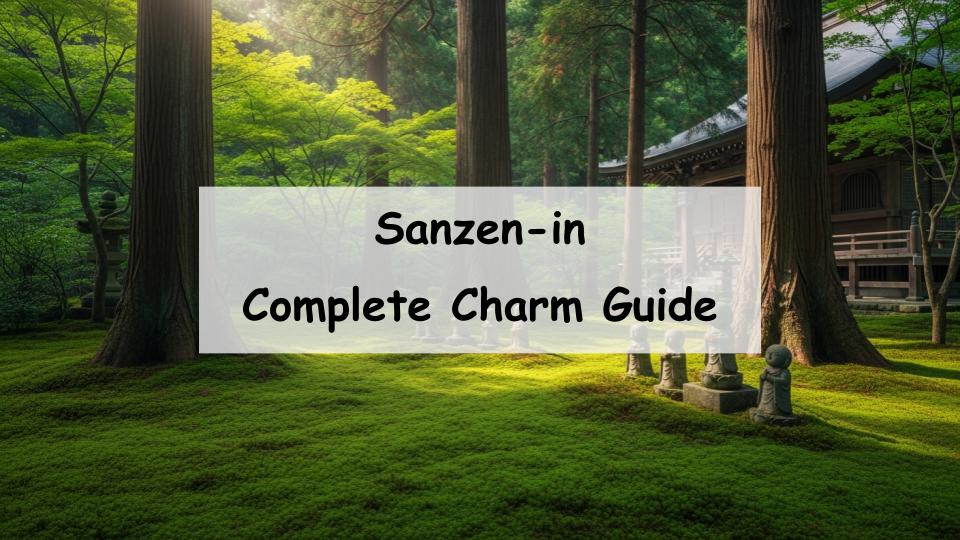
Passing through the Guest Hall and going outside, “Yuseien,” the scenery symbolizing Sanzen-in, spreads out. This is a strolling pond garden, where the contrast between the cedar trees stretching high into the sky and the lush green moss covering the ground like velvet is a masterpiece. The sight of sunlight filtering through the trees and illuminating the moss is magical, filled with fresh air that makes you want to take a deep breath. One of the charms of this garden is that you can enjoy different colors depending on the season, such as rhododendrons in spring and red leaves in autumn.
Ojo Gokuraku-in: Worshipping the National Treasure Amida Trinity
The hall standing quietly in the moss garden of Yuseien is “Ojo Gokuraku-in.” It is an Important Cultural Property built in the Heian period and is essential when talking about the history of Sanzen-in. Inside the hall, the “Amida Sanzon” (Amida Trinity statues), designated as National Treasures, are enshrined. A major feature is that the attendant Bodhisattvas, Kannon and Seishi, flanking the central Amida Nyorai, are sitting in a “Yamato-suwari” pose (a slightly forward-leaning kneeling posture). This is said to represent their merciful figure trying to immediately go and welcome people seeking salvation.

Warabe Jizo: Adorable Statues in the Moss Garden
As you stroll through Yuseien, you will notice several small Jizo statues peeking out from the fluffy moss. These are called “Warabe Jizo” (Child Jizo) and were created by sculptor Takashi Sugimura. Their expressions and gestures vary—some are praying, some are resting their chins on their hands, and others are snuggling together—soothing the hearts of those who see them. They are very popular as a photo spot, and the scenery woven by the green of the moss and the cuteness of the Jizo is a unique healing experience at Sanzen-in.

Konjiki Fudo-do and Kannon-do: Popular Spiritual Sites
Proceeding further back from Yuseien, you will find the Konjiki Fudo-do (Golden Fudo Hall). This is a dojo where Goma fire rituals are performed, and a secret Golden Fudo Myo-o is enshrined as the principal image. It is considered a “power spot” for warding off evil and bringing good luck, where many worshipers join their hands in prayer. Nearby is the Kannon-do, where a 3-meter-tall golden Kannon statue is enshrined, watching over visitors with a gentle expression. This area is located on slightly higher ground, allowing you to overlook the surrounding nature.

Hydrangea Garden and Seasonal Scenery (Cherry Blossoms, Autumn Leaves, Snow)
Sanzen-in is a place where you can enjoy beautiful scenery throughout the year, but it is also famous for the “Hydrangea Festival” held in early summer. There is a vast hydrangea garden around the Konjiki Fudo-do, where thousands of hydrangeas bloom from mid-June to July. The sight of blue and purple flowers floating inside the cedar grove is very mysterious. Of course, you can enjoy the beauty of Japan’s four seasons whenever you visit: weeping cherry blossoms in spring, the grounds wrapped in burning autumn colors in fall, and silent snowy landscapes in winter.
Basic Information (Hours, Fees, Duration)
Here is a summary of basic information such as visiting hours and fees to check before your visit.
Opening Hours and Holidays
Sanzen-in is usually open from 9:00 AM to 5:00 PM. However, the closing time may be earlier depending on the season, so it is safe to check the official website in advance. For example, in winter (December to February), the closing time tends to be a little earlier in the evening. There are basically no closed days, and visitors are welcomed year-round.
Admission Fees and Discounts
The admission fee is set at roughly 700 yen for adults, 400 yen for junior high and high school students, and 150 yen for elementary school students. Discounts may apply for groups of 30 or more. While credit cards or e-money might be accepted depending on the reception status, it is generally recommended to have cash and small change ready for smooth entry.
Estimated Visiting Time
Since the grounds of Sanzen-in are large and there are many highlights, you should budget about 40 to 50 minutes just for a quick walk-through. If you plan to have matcha at Shuhekien, observe the Buddhist statues at Ojo Gokuraku-in carefully, or extend your walk to the hydrangea garden, we recommend planning for 1 to 1.5 hours. If you want to take photos and stroll slowly, securing even more time would be best.
Types of Goshuin (Temple Stamps)
For those collecting Goshuin (temple stamps), Sanzen-in is an attractive spot. You can receive several types of stamps here. Representative ones include the principal image “Yakushi Nyorai,” the “Amida Sanzon” of Ojo Gokuraku-in, and the “Konjiki Fudo-son” of the Golden Fudo Hall. Original Goshuin books are also sold, and designs featuring the crest of Sanzen-in are popular as souvenirs of the pilgrimage.

Access to Sanzen-in (How to Get There)
Ohara, where Sanzen-in is located, is northeast of the Kyoto city center, and the main means of transportation is by bus. Here are the typical access routes.
From Kyoto Station by Bus
From Kyoto Station, it is convenient to use Kyoto Bus Route 17 bound for “Ohara” as there are no transfers. The bus departs from the terminal in front of the Central Exit (platform C3, etc.), and the travel time is usually about 60 minutes. However, during tourist seasons and weekends, roads in Kyoto city are congested, so it may take nearly an hour and a half. After getting off at the final stop “Ohara,” you will walk up a gentle slope on the approach for about 10 minutes to reach Sanzen-in.
From Subway “Kokusaikaikan Station” by Bus
If you want to avoid congestion or save time, we recommend taking the Kyoto Municipal Subway Karasuma Line to the terminal “Kokusaikaikan Station” and transferring to a bus there. If you take Kyoto Bus Route 19 bound for “Ohara” from the bus terminal in front of the station, you will arrive at the Ohara bus stop in about 20 minutes. Since you can avoid traffic jams in the city center, this route is often smoother, especially during the autumn foliage season.
By Car and Parking Info
If accessing by car, head north from Kyoto city on Route 367 (Saba Kaido) toward Ohara. Sanzen-in itself does not have a free parking lot for worshipers, but there are many private paid parking lots dotted around the entrance to the approach and the bus stop. Fees vary depending on the location and season, but many places are around 500 yen per day. You will have to walk from the parking lot to Sanzen-in, so visiting in comfortable walking shoes is recommended.
Recommended Lunch & Sightseeing Spots Nearby
If you have traveled all the way to Ohara, please enjoy the gourmet food and other temples in the area as well as Sanzen-in.
Enjoy Ohara’s Famous “Shibazuke” and Kyoto Vegetables
Along the approach from the Ohara bus stop to Sanzen-in, many souvenir shops and restaurants are lined up. Ohara is famous as a production area for “Red Shiso,” and the famous “Shibazuke” (pickles) is a dish you definitely want to taste. For lunch, there are shops serving obanzai (Kyoto-style home cooking) using fresh Kyoto vegetables, pasta with Shibazuke flavor, or tea over rice buffets using local ingredients. Why not take a break with local tastes in between your walks?
Visit “Hosen-in” and “Jikko-in”
There are other attractive temples very close to Sanzen-in. “Hosen-in” is famous for its “Frame Garden,” where the garden is viewed through the space between pillars as if it were a picture frame. The powerful appearance of the 700-year-old five-needle pine is a must-see. Also, at “Jikko-in,” you can see the rare “Fudanzakura” (constant cherry blossom) which keeps blooming from autumn to spring. Many temples offer plans that include matcha and sweets, so touring gardens is one of the real pleasures of Ohara sightseeing.
Summary
Sanzen-in is a temple full of diverse charms, such as moss-covered beautiful gardens, historic National Treasure Buddhist statues, and heart-soothing Warabe Jizo. Although it is a bit of a distance from the center of Kyoto, you can spend a special time wrapped in rich nature and silence. Sanzen-in, which shows different expressions each season, will surely give new emotions to both first-time visitors and repeaters. Please use this article as a reference to plan your trip to Ohara and Sanzen-in.
A Message from the Guide

It is a wonderful temple with unique charms in every season, offering a fresh and moving experience no matter when you visit.



Comment