“Kodai-ji Temple” is located in the Higashiyama area of Kyoto. Famous as the temple associated with Nene (Kita-no-mandokoro), the lawful wife of Toyotomi Hideyoshi, it is a popular destination. However, those planning a visit for the first time might have questions or uncertainties such as:
“What exactly are the specific highlights of Kodai-ji?”
“I’ve heard the gardens and light-ups are famous, but what are they really like?”
“I want to know the smoothest way to get there to combine it with other sightseeing spots.”
To give you the conclusion first, Kodai-ji is a must-visit spot where you can fully experience the essence of Kyoto through its beautiful seasonal scenery, architecture that embodies the best of Momoyama culture, and exquisite Makie lacquerware.
In this article, we will explain in detail everything you need to know before visiting Kodai-ji, including its “history and characteristics,” “highlights you absolutely cannot miss,” and “access methods to ensure you don’t get lost.”
Reading this article will help you deeply understand the charm of Kodai-ji and make your actual visit more fulfilling. Please use this as a reference for your trip and read until the end.
What is Kodai-ji? A Temple Filled with the Love of Hideyoshi and Nene
Kodai-ji, located in Higashiyama, Kyoto, is formally known as “Kodai Jusho Zenji.” It is widely known as the place where Kita-no-mandokoro (Nene), the wife of Toyotomi Hideyoshi, spent her later years praying for the repose of her late husband’s soul. Here, we will explain its historical background and cultural value.
History and Origin of Kodai-ji
The history of Kodai-ji dates back to 1606 (Keicho 11). After Hideyoshi’s death, Nene became a nun, taking the name Kodai-in Kogetsu-ni, and established this temple to mourn her husband. Tokugawa Ieyasu, the ruler at the time, provided significant financial support for its construction. As a result, a magnificent and prestigious temple was completed, reflecting both political considerations and respect. Although the temple was originally even more vast and splendid than it is today, and despite suffering from repeated fires, the buildings that retain their original form are still carefully preserved. It attracts many history fans and tourists as a place where one can feel the story of Hideyoshi and Nene.
“Kodai-ji Makie” – The Essence of Momoyama Culture
One thing that cannot be overlooked when talking about Kodai-ji is the decorative technique called “Kodai-ji Makie.” This is one of the representative lacquer crafts of the Momoyama period and is mainly seen in the interior decoration of the Otamaya (mausoleum). A technique called “Hiramakie,” in which gold powder is sprinkled on a black lacquer base to draw patterns, is used, combining pictorial grace with strength. In particular, designs featuring familiar plants such as autumn grasses were novel and strongly reflected the aesthetic sense of that era. It has extremely high artistic value and conveys the brilliance of the flamboyant Momoyama culture to the present day.
5 Must-See Highlights at Kodai-ji
Scattered throughout the vast precincts are buildings designated as Important Cultural Properties and beautiful nature that soothes the soul. Here, we will introduce five points that first-time visitors should absolutely see.
1. The Beautiful “Hashin-te” Garden
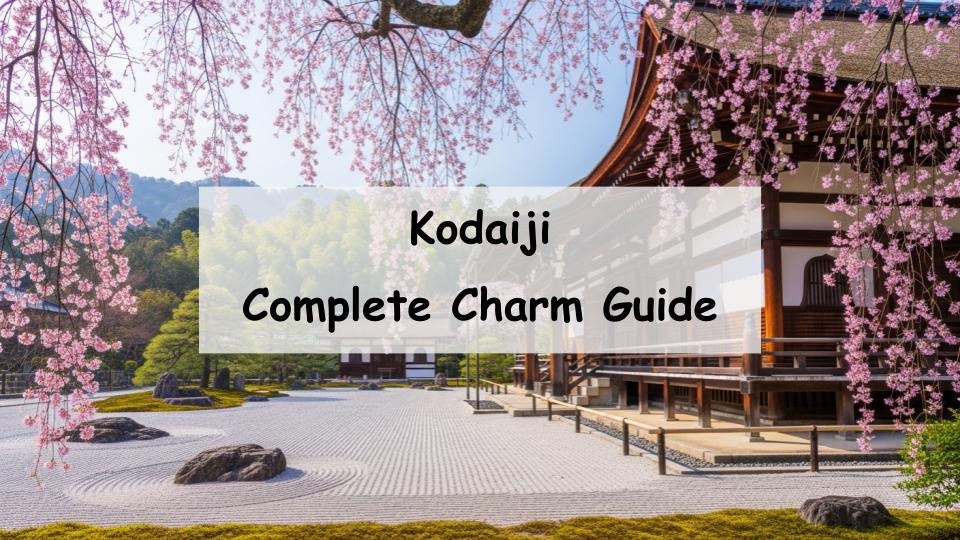
The “Hashin-te” garden in front of the Hojo (Main Hall) is very famous as a dry landscape garden (Karesansui). Standing stones and moss are arranged in a spacious area covered with white sand, allowing you to feel the spirit of Zen amidst the silence. In spring, the weeping cherry tree in the corner of the garden blooms in full glory, creating a magnificent view in contrast with the white sand. Since autumn leaves add color in the fall, you can enjoy different expressions no matter which season you visit.

2. Important Cultural Properties “Kaizando” and “Kangetsudai”
The “Kaizando” (Founder’s Hall) standing in the garden is a precious building that remains from the time of Kodai-ji’s founding and is designated as an Important Cultural Property. Located on the corridor connecting the Kaizando and the study is the “Kangetsudai” (Moon Viewing Pavilion). It is a small building with a cypress bark roof, and it is said that Nene used to view the moon from here while thinking of her late husband, Hideyoshi. Its structure, built to extend over the pond, is very tasteful and allows you to imagine the elegant lifestyle of that time.
3. The “Otamaya” Mausoleum Enshrining Hideyoshi and Nene
Located in the secluded part of the precincts, the “Otamaya” is a hall that enshrines wooden statues of Hideyoshi and Nene. This is considered a particularly sacred place within Kodai-ji, and the interior of the building is luxuriously decorated with the previously mentioned Kodai-ji Makie. The dais and shrines are decorated with intricate patterns using gold and lacquer, and their beauty is breathtaking. Nene’s own remains are buried underground in this mausoleum, making it truly the place where the souls of the couple rest.
4. Unique Tea Houses “Kasa-tei” and “Shigure-tei”
Climbing up the small hill, you will find two tea houses, “Kasa-tei” and “Shigure-tei,” which are said to have been relocated from Fushimi Castle. Kasa-tei (Umbrella Pavilion) is characterized by its ceiling made of bamboo assembled radially, looking just like an opened traditional umbrella. On the other hand, Shigure-tei is a rare two-story tea house, and it is said that in those days, one could overlook the Osaka area from the second floor. These two buildings, connected by an earthen corridor, convey the free and original architectural beauty that draws on the design of Sen no Rikyu.

5. The “Bamboo Grove” Popular as an Instagram Spot
After viewing Kasa-tei and Shigure-tei, if you go down along the route, a magnificent bamboo grove appears. While the bamboo grove in Arashiyama is famous in Kyoto, the bamboo grove at Kodai-ji is also exceptional. Bamboo stretching high toward the sky surrounds both sides of the path, creating a dim and mystical atmosphere even during the day. The space wrapped in silence feels like it washes your mind, and it is also very popular as a photo spot.
Seasonal Visits: Light-ups and Scenery
Kodai-ji focuses not only on daytime viewing but also on special night viewings and seasonal events. The illumination effects are said to be among the most beautiful in Kyoto.
Spring Cherry Blossoms and Autumn Leaves Special Viewing
The light-ups held during the spring cherry blossom season and the autumn foliage season attract many tourists. In particular, the reflection of the autumn leaves on the surface of Garyu Pond is described as having “mirror-like beauty,” and that fantastic scene is worth seeing at least once. In the Hojo front garden, light performances matching the theme of the year are sometimes held, allowing you to enjoy the fusion of traditional temple architecture and modern illumination.
Summer “Night Parade of One Hundred Demons” and Projection Mapping
In summer, special exhibitions featuring ghosts and yokai (monsters) are sometimes held in conjunction with the public opening of the “Hyakki Yako Emaki” (Picture Scroll of the Night Parade of One Hundred Demons) owned by Kodai-ji. Additionally, summer-limited light-ups and projection mapping may take place, delivering coolness and surprise to the humid summer nights of Kyoto. One of Kodai-ji’s great charms is its stance of actively incorporating new technologies while possessing a long history.
Goshuin, Amulets, and Basic Info
Receiving a Goshuin (temple stamp) as proof of your visit or purchasing an amulet as a memento is also part of the fun of traveling. Here, we summarize practical information regarding visitation.
Goshuin Types and Location
At Kodai-ji, you can mainly receive a Goshuin with the word “Busshin” (Buddha’s Heart) written on it. This is a word expressing the heart of Zen that Nene believed in. Depending on the season, limited edition Goshuin may appear, so it is a good idea to check at the conferment office. Goshuin and amulets can be requested at the conferment office near the entrance or near the exit. Cute amulets for women, associated with Nene, are also popular.

Opening Hours and Fees
Normal visiting hours are from 9:00 AM to 5:00 PM, with reception closing at 5:00 PM. However, during the light-up periods, hours are extended for special night viewing, so we recommend checking the schedule on the official website in advance. The entrance fee is 600 yen for adults and 250 yen for junior high and high school students. A common discount ticket including admission to the “Sho Museum of Art” and “Entoku-in,” which will be mentioned later, is also sold, so using that is economical if you plan to visit multiple places.
How Long Does a Visit Take?
The time required to look around the precincts of Kodai-ji is approximately 40 minutes to 1 hour. It is better to allow a little extra time if you plan to take photos or climb up to the tea houses on the high ground. During the busy spring and autumn seasons, it may take more time to wait at the reception or for Goshuin, so it is important to plan with time to spare.
Access to Kodai-ji (How to Get There)
Choosing transportation is important for sightseeing in Kyoto. Here are the main access methods to get to Kodai-ji.
From Kyoto Station (Bus/Taxi)
When heading from Kyoto Station, the most common method is to use the city bus. Board the “No. 206” bus from the bus terminal in front of Kyoto Station and get off at the “Higashiyama Yasui” bus stop. From there, it takes about 7 minutes to walk east. If you have a lot of luggage or want to save time, using a taxi is also a wise choice. If you take a taxi from Kyoto Station, you can arrive in about 15 to 20 minutes, depending on traffic conditions.
From Hankyu “Kyoto Kawaramachi Station” or Keihan “Gion-Shijo Station”
If you use the train, Hankyu Railway’s “Kyoto Kawaramachi Station” or Keihan Railway’s “Gion-Shijo Station” are the nearest stations. It is about a 20-minute walk from either station. Although you will have to walk a bit, it is a recommended route for those who do not mind walking, as you can head there while strolling through the townscape full of Kyoto atmosphere, such as Yasaka Shrine and Ishibe-koji Alley.
Parking and Access by Car
Paid parking is available at Kodai-ji for those visiting by car. There are 24-hour parking lots, but please be aware that the surrounding roads are narrow and become extremely congested during tourist seasons and on weekends. Since it often becomes full, it is often smoother to use public transportation as much as possible or use a coin parking lot a little further away and walk.
Recommended Sightseeing Course Nearby
There are many attractive spots around Kodai-ji that you should visit together. Here is a suggested course for efficient sightseeing.
Visit “Entoku-in” and “Sho Museum of Art” as a Set
Right near Kodai-ji is “Entoku-in,” where Nene spent the last 19 years of her life. Here, the North Garden, which was relocated from the front garden of the Kesho Goten at Fushimi Castle, is designated as a Place of Scenic Beauty. Also, at the “Sho Museum of Art” located along Nene-no-michi (Nene’s Path), furnishings with Kodai-ji Makie and treasures associated with Hideyoshi and Nene are exhibited. If you use the common admission ticket mentioned earlier, you can tour these three places at a discount, so please visit them as a set.
From Nene-no-michi to Kiyomizu-dera
The street in front of Kodai-ji is called “Nene-no-michi” and is maintained as a beautiful cobblestone walking path. Proceeding south from here leads to atmospheric sloping streets such as “Ninenzaka” and “Sannenzaka.” Climbing these slopes lined with souvenir shops and cafes, you will arrive at the World Heritage Site, Kiyomizu-dera Temple. The route from Kodai-ji to Kiyomizu-dera is very popular as a classic course for Higashiyama sightseeing.
Summary
Kodai-ji is a place where the love story of Hideyoshi and Nene lives on, and it is a temple with diverse highlights such as beautiful gardens and architecture that gathers the essence of Momoyama culture. One of its charms is that there are always new discoveries every time you visit, such as seasonal light-ups and fusion with modern art. Access from Kyoto Station and downtown areas is good, and there are many famous places such as Entoku-in and Kiyomizu-dera nearby, making it ideal as a base for Higashiyama sightseeing. On your next trip to Kyoto, please visit Kodai-ji and spend a special time woven by history and beauty.
A Message from the Guide

It’s a wonderful temple where you can deeply feel the history, yet it’s also incredibly Instagrammable.



Comment