
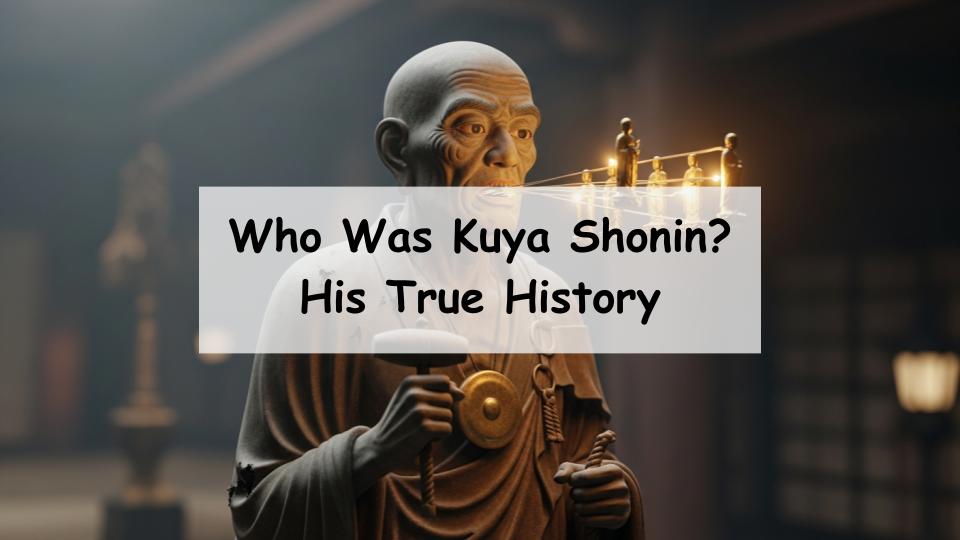
Many people have seen the famous statue of Kuya Shonin—a monk with small Buddha figures emerging from his mouth—either in history textbooks or at Rokuharamitsuji Temple in Kyoto. However, despite the strong impact of his appearance, few can answer the questions: “What exactly did he do?” or “What kind of life did he lead?”
This article explains the life and achievements of Kuya Shonin in a way that is easy to understand.
In conclusion, Kuya Shonin was a pioneer of the mid-Heian period who spread the “Namu Amida Butsu” chant (Nembutsu) to the common people. At the same time, he was a social worker who dedicated himself to infrastructure projects like road repairs and well-digging. Because of his closeness to the people, he was deeply loved and revered as the “Saint of the Market” (Ichi no Hijiri).
In this article, we will focus on the four major achievements Kuya Shonin left in history and unravel his lesser-known background. By reading this, you will understand the true greatness of Kuya Shonin and deepen your understanding of Japanese history.
Who Was Kuya Shonin? His Identity and Background
Kuya Shonin was a monk active in the mid-Heian period, a time when he was a unique figure in the Buddhist world. Rather than belonging to a specific sect and staying secluded in a temple, he chose to enter the bustling city streets to spread his teachings. First, let’s look at the mysteries surrounding his birth and why he earned his unique titles.
The Mysterious Birth and the Imperial Lineage Theory
There are few certain records regarding Kuya Shonin’s birth, leaving much of it shrouded in mystery. However, the most prominent theory passed down is that he was a son of Emperor Daigo (an illegitimate child, or rakuin). If this theory is true, it means he was born into the highest nobility but chose to discard his status and fame to become a monk living for the common people. This dramatic background lends weight to his lifestyle of distancing himself from state power to remain on the side of the ordinary citizens.
Why He Was Called the “Saint of the Market” or “Amida Saint”
Kuya Shonin was affectionately known as “Ichi no Hijiri” (Saint of the Market) or “Amida Hijiri” (Saint of Amida). At that time, Buddhism was primarily for the aristocracy to pray for the protection of the state or worldly benefits, making it distant from the lives of commoners. However, Kuya Shonin stepped out of the temples and into the “Ichi” (markets) and streets where people gathered. Because he earnestly chanted “Namu Amida Butsu” there and preached that anyone could be saved, he came to be called the “Saint of the Market.”
4 Achievements of Kuya Shonin that Changed History
Kuya Shonin remains in history books not just because of his unique character, but because his activities significantly changed the nature of Japanese Buddhism and addressed the social issues of his time. Here are his four representative achievements.
[Achievement 1] Popularizing the “Namu Amida Butsu” Chant
Kuya Shonin’s greatest achievement was popularizing the “Shomyo Nembutsu”—the practice of simply chanting “Namu Amida Butsu” aloud. Until then, Buddhist training required reading difficult sutras or following strict commandments, which was impossible for commoners. Kuya Shonin taught that anyone could be reborn in the Pure Land simply by relying on Amida Buddha and chanting the Nembutsu. This laid the essential groundwork for the spread of Pure Land Buddhism across Japan and heavily influenced later figures like Honen and Shinran in the Kamakura period.
[Achievement 2] Inventing the “Dancing Nembutsu” (Odori Nembutsu)
To spread the Nembutsu, Kuya Shonin devised a unique method to attract people’s attention: the “Odori Nembutsu” (Dancing Nembutsu). This involved beating bells and drums and chanting while dancing to the rhythm. For the common people of the time, this method was entertaining, approachable, and easy to remember. Praying to the rhythm of sound and movement was a religious ceremony, but also a communal event that created a sense of unity. This tradition was later developed further by Ippen Shonin and is said to be one of the origins of the modern Bon Odori dance.

[Achievement 3] Social Work: Bridges, Wells, and Infrastructure
Kuya Shonin addressed not only the salvation of souls but also the improvement of people’s living environments. Alongside his preaching, he repaired ruined roads, built bridges, and dug wells in places suffering from water shortages. While these public works were technically the responsibility of the state, Kuya Shonin and his followers stepped in where the government failed. He embodied the spirit of “altruism,” showing that chanting the Nembutsu and performing good deeds were inseparable.
[Achievement 4] Founding Saiko-ji (Rokuharamitsuji) to Fight Epidemics
In 951 (Tenryaku 5), when a severe epidemic plagued Kyoto, Kuya Shonin carved an Eleven-Faced Kannon statue to pray for its end. He placed the statue on a cart, pulled it through the city, and served “Obukucha” (tea with pickled plum and kelp) to the sick while chanting the Nembutsu. The temple established as the base for these activities was Saiko-ji, the predecessor of the current Rokuharamitsuji Temple. This demonstrates that he was not just a religious figure, but a savior who worked on the front lines during social crises like disasters and plagues.

Why Are Buddhas Coming Out of His Mouth? The Hidden Meaning of the Statue
You cannot talk about Kuya Shonin without mentioning the Standing Statue of Kuya Shonin, a designated Important Cultural Property. The figure of a gaunt old monk with a gong around his neck and six small Buddhas emerging from his mouth is unforgettable. This seemingly eccentric design holds deep religious meaning.
What the 6 Amida Buddhas Represent
The six small Buddhas attached to a wire coming out of his mouth visualize the six syllables of the chant “Na-Mu-A-Mi-Da-Butsu.” It represents the legend that “with every invocation, a Buddha appears.” This artistic expression shows that his chant was not just empty words, but that the Nembutsu itself possessed the power and presence of the Buddha.
A Masterpiece by Kosho, Son of Unkei
This realistic and symbolic statue was created by Kosho, the fourth son of the famous Kamakura period sculptor Unkei. Although the statue was made centuries after Kuya Shonin died, Kosho perfectly captured his essence as the “Saint of the Market.” The simple robes, the straw sandals, and the posture of striking the gong while walking—leaning slightly forward—realistically recreate Kuya Shonin living among the people, chanting endlessly. This statue is enshrined at Rokuharamitsuji Temple and continues to fascinate visitors today.

Kuya Shonin’s Life and Lasting Influence
Kuya Shonin’s activities influenced not only the capital of Heian-kyo but also the long-term development of Japanese culture and Buddhism. Finally, let’s look at his life from his training days to his passing, and the traditions that continue today.
From Traveling Monk to His Passing
Kuya Shonin became a monk in his 20s and spent his youth traveling the provinces for ascetic training. He did not follow a specific master initially, prioritizing practice over the study of sutras, with records of his activities in places like the Kokubunji temple in Owari Province. Later, he returned to Kyoto and officially received the precepts at Enryakuji on Mt. Hiei, becoming a Tendai monk, but he continued his activities in the city streets. He spent his later years at what is now Rokuharamitsuji and passed away in 972 at the age of 70. His lifelong stance of “Buddhism for the people” was deeply engraved in the hearts of many.

The Tradition of “Kuya Nembutsu” Today
The “Kuya Nembutsu,” stemming from the Dancing Nembutsu he started, has been passed down through the ages. Every December, Rokuharamitsuji Temple holds the “Kuya Yuyaku Nembutsu,” which is designated as an Important Intangible Folk Cultural Property. Monks strike gongs and chant the Nembutsu with a unique melody while moving their bodies. This ritual brings the figure of Kuya Shonin from over a thousand years ago back to life in the modern world. His teachings are not just historical events but living traditions.
Summary
Kuya Shonin was a revolutionary monk who preached a path of salvation for everyone, regardless of social status, in the aristocracy-centered Heian society. Unraveling his history reveals four key achievements:
- Popularizing the Shomyo Nembutsu (simply chanting “Namu Amida Butsu”).
- Spreading teachings through the accessible Dancing Nembutsu.
- Supporting people’s lives through social works like infrastructure improvements.
- Founding Saiko-ji (Rokuharamitsuji) to save people from epidemics.
By understanding these great deeds, rather than just the image of the statue with Buddhas coming out of its mouth, we can understand why he was revered as the “Saint of the Market.” His life serves as a pioneering model not only for religious figures but also for social contributors, offering many lessons for us today.
A Message from the Guide

While the statue at Rokuharamitsuji Temple is famous, there is no doubt that he was an essential figure in the spread of Japanese Buddhism.



Comment