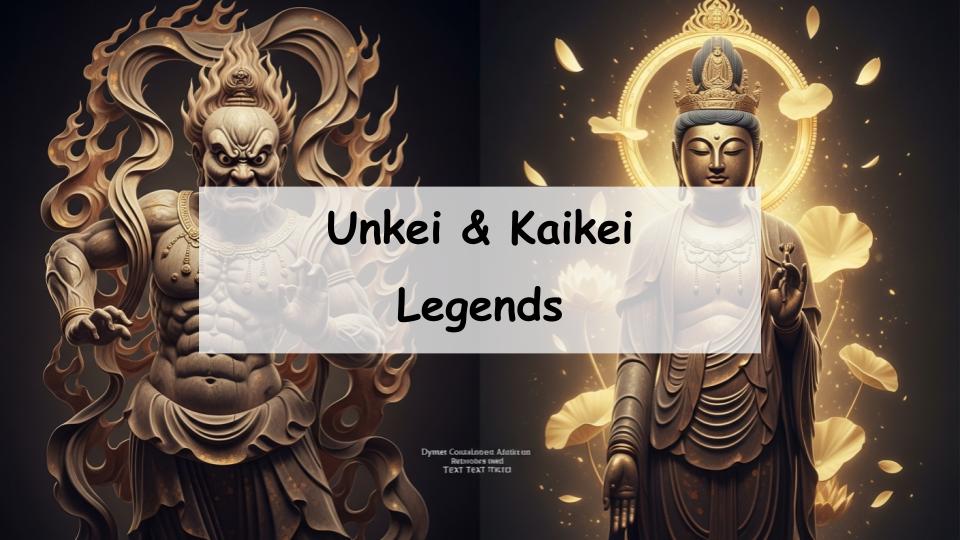
“Unkei” and “Kaikei.”
If you have read history textbooks on Japan or traveled to Nara and Kyoto, you have likely heard these names at least once.
The massive Kongo Rikishi (Guardian King) statues at the Great South Gate of Todaiji Temple are particularly famous, but many people may wonder:
“I remember their names as a set, but what exactly makes them so amazing?”
“What are the differences between their artistic styles?”
In conclusion, they were genius Buddhist sculptors (Busshi) who established the “Kei School” (Kei-ha), a style overflowing with realism during the Kamakura period. Their greatest appeal lies in their contrasting styles: Unkei, the master of “Motion,” and Kaikei, the master of “Stillness.”
This article explains the relationship and history of Unkei and Kaikei that you should know, as well as the “5 Overwhelming Charms” of their statues that continue to captivate people today. Understanding the differences between the two will undoubtedly make your future appreciation of Buddhist statues many times more interesting.
- Who were Unkei and Kaikei? The History of the “Kei School,” the Strongest Sculptors in Japanese History
- What Makes Unkei and Kaikei’s Statues Amazing? 5 Overwhelming Charms
- Charm 1: “Realism” That Looks Like It’s Alive
- Charm 2: “Gyokugan” (Crystal Eyes) That Breathe Life into the Statues
- Charm 3: Dynamic “Physical Beauty” Expressing Muscles and Veins
- Charm 4: “Drapery” Expression Created by Deep Folds and Three-Dimensionality
- Charm 5: Expressions Full of “Humanity” Reflecting the Atmosphere of the Times
- “Dynamic” Unkei and “Static” Kaikei! Points to Distinguish Their Styles
- Must-See! Representative Works of Unkei and Kaikei and Where to Find Them
- Summary: Knowing Unkei and Kaikei Deepens Buddhist Statue Appreciation
- A Message from the Guide
Who were Unkei and Kaikei? The History of the “Kei School,” the Strongest Sculptors in Japanese History
In the history of Japanese sculpture, the group that brought about the most innovative and dynamic transformation was the sculptor guild known as the “Kei School” (Kei-ha). The central figures were Unkei and Kaikei, and their emergence caused a dramatic evolution in Japanese Buddhist imagery. Here, we unravel the background of their success, their lives, and their relationship.
What is the Kei School? A Revolution from Heian to Kamakura
The Kei School was a faction of Buddhist sculptors based in Nara who were active from the late Heian period through the Kamakura period. They are called this because many of their names contained the character “Kei” (慶).
Until then, Buddhist statues of the Heian period were dominated by the “Jocho style”—graceful, calm, and preferred by aristocrats. However, following the destruction of the southern capital (Nara) by the Taira clan, the Kei School rose to prominence during the reconstruction. They pursued powerful, realistic forms that matched the temperament of the samurai (warriors), who were the new rulers of the era. This shift from “Heian elegance” to “Kamakura sturdiness” was truly a revolution in Japanese art history.
Unkei’s Life: The Genius of “Motion” Loved by Warrior Society
Unkei was born as the son of Kokei, the de facto leader of the Kei School. He demonstrated his talent from a young age, making a brilliant debut with the Dainichi Nyorai statue at Enjoji Temple in Nara.
Unkei’s most significant characteristic was his strong connection with the newly emerging Kamakura Shogunate. Eastern warriors, such as the Hojo clan, projected their own ideals onto the powerful, masculine statues created by Unkei. Throughout his life, Unkei continued to produce passionate and innovative works, eventually rising to the rank of “Hoin,” the highest rank for a Buddhist sculptor. His life was dedicated to giving form to the energy of the new era.

Kaikei’s Life: The Technician of “Stillness” Who Captivated the Masses
On the other hand, Kaikei was a disciple of Kokei (Unkei’s father). Essential to his story is his meeting with the monk Chogen, who was responsible for the reconstruction of Todaiji Temple, and his devout faith in Amida Buddhism.
Kaikei took pride in his skills, calling himself a “master artisan” (Takumi), and left behind many extremely intricate and beautiful statues. He also devoted himself to creating statues for the worship of the general public, not just specific powerful figures. His refined and approachable style was widely accepted by the masses, and the style he established became a model for later Buddhist sculpture.
Their Relationship: Fellow Disciples or Rivals?
Unkei and Kaikei were fellow disciples under Kokei. Unkei was the master’s biological son and the heir apparent, while Kaikei was a high-ranking apprentice who made a name for himself through sheer ability.
Although their styles were contrasting, they were not on bad terms. They collaborated on large-scale projects, such as the Kongo Rikishi statues at Todaiji’s Great South Gate. They are considered to have been good rivals who recognized each other’s talents and pushed one another to improve, acting like the two wheels supporting the “Kei School” team.
What Makes Unkei and Kaikei’s Statues Amazing? 5 Overwhelming Charms
There are clear reasons why the works of Unkei and Kaikei continue to move us today. It lies in the realism they thoroughly pursued and the spirituality embedded within. Here, we explain five overwhelming charms common to Kei School statues.
Charm 1: “Realism” That Looks Like It’s Alive
When standing before a Kei School statue, everyone is first surprised by its overwhelming sense of presence. They observed actual human bodies and incorporated that skeletal structure and fleshiness into their statues. Unlike previous statues that were overly idealized objects of worship, Kei School statues possess a rawness, as if they were “humans standing right next to you.” This thorough realism delivers a strong impact and sense of familiarity to the viewer.
Charm 2: “Gyokugan” (Crystal Eyes) That Breathe Life into the Statues
The reason the eyes of Kei School statues seem to glint is due to a technique called “Gyokugan” (Crystal Eyes). This involves carving out the head of the statue from the inside and inserting crystal into the eye sockets. By painting pupils on the back of the crystal, a moisture and shine resembling actual eyeballs are created. While this technique existed before the Kei School, they adopted it as a standard and heightened the reality of facial expressions to the limit, giving the statues the power of having a “soul.”
Charm 3: Dynamic “Physical Beauty” Expressing Muscles and Veins
Particularly noticeable in guardian statues like the Kongo Rikishi is the anatomically accurate representation of the body. Bulging muscles, protruding veins, and the tension of tendons at the moment of exertion—these forms could not be created without a deep understanding of the human body structure. This is also a result of the backdrop of the Kamakura period, where warriors rose to power, and a robust physique was preferred as a symbol of strength and justice.
Charm 4: “Drapery” Expression Created by Deep Folds and Three-Dimensionality
There are also unique characteristics in the expression of the robes (drapery) worn by the statues. While the robes of Heian period statues depicted shallow, gentle waves, Unkei and Kaikei carved deep, complex folds. The three-dimensional carving, which allows one to feel the weight and thickness of the cloth, emphasizes the contrast of light and shadow, giving depth and movement to the entire figure. Even in a single fold of cloth, thorough realism is maintained.
Charm 5: Expressions Full of “Humanity” Reflecting the Atmosphere of the Times
The “humanity” glimpsed within the divinity is also a major attraction. Even in an angry expression, it is not just scary; there is a depth that conveys the sorrow or sense of mission behind it. Furthermore, in portrait sculptures, the aging and personality of the model were carved without concealment. The creation of expressions that feel somewhat human, despite being noble beings, is a factor that resonates with modern hearts.
“Dynamic” Unkei and “Static” Kaikei! Points to Distinguish Their Styles
Unkei and Kaikei are both giants of the Kei School, but their styles are surprisingly contrasting. Understanding this difference significantly increases the “resolution” of your appreciation of Buddhist statues.
Unkei’s Features: Overwhelming Volume and Rough Power
If Unkei’s style were to be expressed in one word, it would be “Motion.” His statues are voluminous and have a heavy, rock-like presence. Characterized by rough power, he excels at intense emotional expressions that overwhelm the viewer. The forms, which are never overly tidy but rather look like an explosion of life energy, can be said to be the pinnacle of masculine beauty. The reason warriors preferred Unkei was precisely because they were drawn to this unwavering strength.
Kaikei’s Features: Painterly Delicacy and the “An’nami Style”
In contrast, Kaikei’s style is “Stillness.” His statues have slender proportions and are as delicate and arranged as a painting. In particular, the style of Amida Nyorai he established is called the “An’nami Style” (An’nami-yo), characterized by long, slit eyes, an intellectual expression, and flowing, beautiful drapery. The refined structural beauty, which anyone would find “beautiful,” is a sophisticated style at the opposite end of Unkei’s roughness.
The Collaboration of the Century! Role Division of the Todaiji Nandaimon “Kongo Rikishi Statues”
The masterpiece where the personalities of Unkei and Kaikei collided and fused is the National Treasure Kongo Rikishi Statues (Nio Guardians) at the Great South Gate of Todaiji Temple. It is said that these colossal statues, exceeding 8 meters in height, were completed in just 69 days. Generally, it is believed that Unkei and Kaikei led the creation of the open-mouthed “Agyo” statue, while Jokaku and Tankei (Unkei’s son) were in charge of the closed-mouthed “Ungyo” statue. This project was a massive undertaking for the entire Kei School, a miraculous collaboration in the history of Japanese sculpture where Kaikei’s high technical skills were fully demonstrated under Unkei’s direction.
Must-See! Representative Works of Unkei and Kaikei and Where to Find Them
Finally, here are the places where you can actually meet the masterpieces of Unkei and Kaikei. The emotion received from seeing the real thing is on a completely different level than seeing photos. Please visit these sites and feel their spirit.
Unkei’s Masterpieces: Kofukuji “Muchaku and Seshin Bodhisattva Standing Statues” and others
Considered the greatest masterpieces of Unkei’s later years are the “Muchaku and Seshin Bodhisattva Standing Statues” enshrined in the North Octagonal Hall (Hokuendo) of Kofukuji Temple in Nara. Modeled after real Indian brother monks, these statues are filled with the quiet dignity of enlightened ones and an overwhelming realism that turns even aging into beauty. The “Miroku Buddha Sitting Statue” in the same hall and his debut work, the “Dainichi Nyorai Sitting Statue” at Enjoji Temple, are also must-sees. Following the path of Unkei’s evolution is also a joy.
Kaikei’s Masterpieces: Todaiji “Sogyo Hachiman Sitting Statue,” Jodoji “Amida Triad” and others
A place where you can see the essence of Kaikei’s skill is the National Treasure “Sogyo Hachiman Sitting Statue” at Todaiji Temple. Depicting a figure of Shinto-Buddhist syncretism, this statue retains vivid coloring, coexisting with Kaikei-esque neatness and divinity. Also, the “Amida Triad” at Jodoji Temple in Ono City, Hyogo Prefecture, is designed so that the statues glow when receiving the setting sun from the window behind them. It is a precious place where you can experience the worldview of the Pure Land paradise orchestrated by Kaikei.

Touring Nara and Kyoto! Major Temples Where You Can Meet National Treasure Statues
Many works of Unkei and Kaikei remain in Nara, which was their base of activity. Todaiji and Kofukuji can be called the holy lands of the Kei School. In Kyoto, there is the Sitting Statue of Jizo Bosatsu at Rokuharamitsuji Temple, said to be by Unkei. Additionally, Kongobuji Temple in Wakayama houses the Standing Statues of the Eight Great Youths (Hachidai Doji) by Unkei. Appreciating these statues along with the historical background of each temple allows for a deeper understanding of their great achievements.

Summary: Knowing Unkei and Kaikei Deepens Buddhist Statue Appreciation
Unkei and Kaikei were not just technically superior; they were geniuses who stood at a turning point in history and embodied people’s prayers into “form.” Unkei’s powerful and raw “Motion” and Kaikei’s delicate and refined “Stillness.” By knowing these two personalities, you will be able to read the meanings contained in the expressions and physical representations of Buddhist statues.
Why not visit a temple on your next holiday to meet the masterpieces they left behind? The overwhelming power that speaks to us across 800 years is sure to capture your heart.
A Message from the Guide
The appeal of Buddhist statues is profound.
Comment