Chion-ji Temple in Kyoto is widely known as the birthplace of the Japanese proverb, “If three people gather, they have the wisdom of Monju” (similar to “Two heads are better than one”).
While it is a famous spot to visit during a trip to Amanohashidate, you may have some questions before you go:
- “What kind of blessings does Chion-ji offer?”
- “What are the highlights of the grounds and the famous ‘Fan Fortunes’?”
- “How do I get there, and what is the sightseeing like around the area?”
Chion-ji is counted as one of Japan’s “Three Monju Temples” and is a historic temple visited by worshipers from all over the country as a “power spot” for academic success and gaining wisdom. Additionally, the “Suehiro Fan Fortunes” hanging from the pine trees have become a hot topic on social media for their adorable appearance.
In this article, we will thoroughly explain everything from basic information like the history and characteristics of Chion-ji to the must-see highlights of the grounds and specific access methods.
If you are planning a trip to Kyoto, or if you have an entrance exam or qualification test coming up, please read to the end and use this as a reference for your travels.
- What is “Chion-ji Temple” in Amanohashidate, Kyoto?
- Top 5 Highlights of Chion-ji Temple
- Chion-ji’s Specialty! The Adorable “Suehiro Fan Fortunes”
- Access and Parking Information for Chion-ji
- Basic Information on Chion-ji Opening Hours and Fees
- Sightseeing and Gourmet Spots to Visit Around Chion-ji
- A Message from the Guide
What is “Chion-ji Temple” in Amanohashidate, Kyoto?
Located at the southern end of Amanohashidate—one of Japan’s Three Scenic Views—in Miyazu City, Kyoto Prefecture, Chion-ji is a historic temple that has gathered the faith of people since ancient times. It belongs to the Myoshinji School of the Rinzai Sect and is affectionately known by locals as “Kireto no Monju” or “Kusedo no Monju.” First, let’s look in detail at its history and blessings to understand why this temple is so famous.
Birthplace of “Out of the Counsel of Three Comes Wisdom”
One of the reasons Chion-ji is widely known is that it is the origin of the proverb “Sannin yoreba Monju no chie” (If three people gather, they have the wisdom of Monju). This saying means that even ordinary people can produce wonderful wisdom comparable to that of Monju Bosatsu (the Bodhisattva of Wisdom) if three of them gather and consult with one another. Along with Abe Monju-in in Sakurai City, Nara Prefecture, and Kameoka Monju (or Daishoji) in Takahata Town, Yamagata Prefecture, Chion-ji is counted as one of the “Three Monju Temples of Japan,” establishing a solid status as a representative sacred site for the Bodhisattva of Wisdom.


Popular with Students for Academic Success and Wisdom
The principal image enshrined here, Monju Bosatsu, is the Buddhist deity governing wisdom. Therefore, Chion-ji is believed to bring blessings for academic achievement and passing exams, attracting many students and their families during the exam season. It is a spiritual support not only for school exams but also for qualification exams, job hunting, and for those wishing to be granted the wisdom to make the right decisions at life’s crossroads. In the temple grounds, there are ema (votive tablets) hanging racks filled with earnest wishes for passing entrance exams.

Top 5 Highlights of Chion-ji Temple
Valuable historical buildings and unique monuments are scattered throughout the spacious grounds. Here are five selected highlights of Chion-ji that you should definitely pay attention to when visiting.
The Grand “Sanmon Gate” Also Known as the Golden Pavilion
Standing majestically at the entrance of Chion-ji is the huge Sanmon Gate, which is a designated cultural property of the city. Also called the “Golden Pavilion,” this gate took many years to rebuild and was completed in the late Edo period. Its massive structure and intricate woodwork are overwhelming, creating a beautiful landscape in harmony with the pine trees of Amanohashidate. First, bow before this gate before stepping into the sacred grounds with a solemn heart.
The “Tahoto Pagoda” Designated as an Important Cultural Property
The Tahoto Pagoda, built in the Muromachi period, stands out conspicuously within the grounds. As the only building from the Muromachi period remaining in the Tango region, it is designated as an Important Cultural Property of Japan. The beauty of the roof’s curves and its balanced form are highly evaluated architecturally, and its ancient appearance, having withstood the wind and snow of a long history, leaves a deep impression on visitors.

A Kamakura Period Masterpiece! The “Iron Bath” Now Used as a Water Basin
At the Chozuya (purification font) where you cleanse your hands and mouth before worship, there is a rare water basin not seen elsewhere. This is called the “Iron Bath” (Tetsu-yubune), and it was originally a bathtub used by monks to store hot water for bathing during the Kamakura period. Designated as an Important Cultural Property of Japan, this iron bath is a precious heritage conveying casting techniques from over 700 years ago, and it now holds pure water to welcome worshipers.
The “Wisdom Ring Lantern” That Makes You Smarter?
Right next to Chion-ji, near the sightseeing boat pier, stands a uniquely shaped stone lantern. This structure, called the “Chie no Wa Doro” (Wisdom Ring Lantern), was built in the Edo period to pray for maritime safety and features a distinct ring-shaped light chamber. A legend has been passed down since ancient times that says, “If you pass through this ring three times, you will be granted the wisdom of Monju.” However, since it is made of stone and is quite high, actually passing through it is difficult. Therefore, it is now said that walking around the lantern three times will grant you the blessings.
“Strength Stones” That Grant Power Upon Lifting
In one corner of the grounds, stones of various sizes are placed. These are called “Chikara-ishi” (Strength Stones), and they are said to have been used by people in the past for tests of strength. It is said that power will be granted if you can lift these stones, but some of them are extremely heavy. Touching them and thinking about the strength of people in the old days is also a good experience.
Chion-ji’s Specialty! The Adorable “Suehiro Fan Fortunes”
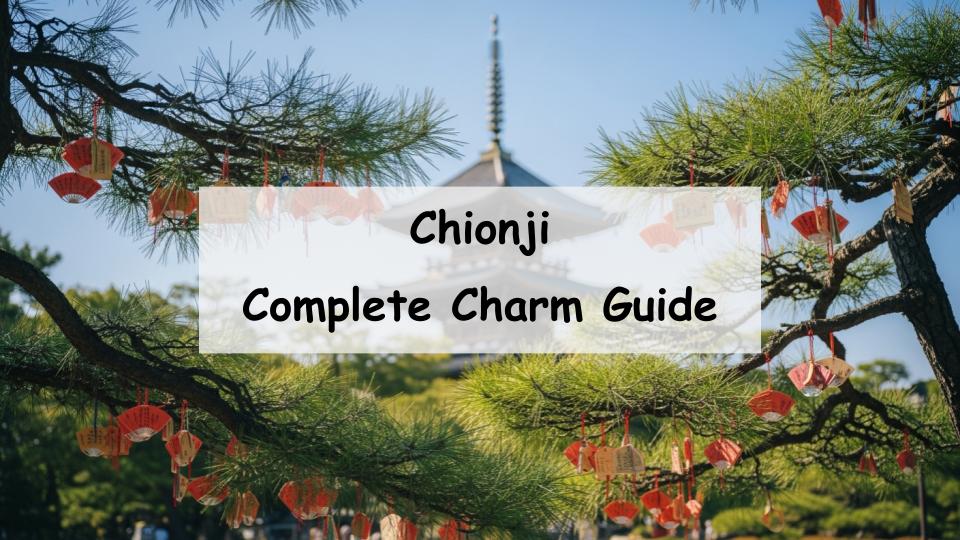
An experience you absolutely must try when visiting Chion-ji is the famous “Suehiro Fan Omikuji” (Fortune Slips). Unlike general paper fortunes, these adorable fan-shaped fortunes are very popular as travel memories.
Fans Hanging from Pine Trees are Perfect for Social Media
Looking up at the pine trees in the grounds, you will likely be surprised by the sight of countless small fans hanging from them. These are the fan fortunes tied by worshipers who drew them, and the scenery woven by green pine needles and colorful fans is extremely photogenic. The sight of fans swaying in the wind is atmospheric, and you will undoubtedly want to take a picture. It is attracting attention as a spot that looks great on social media.
Types of Fortunes and How to Draw Them
You can purchase the fan fortunes at the temple office. Choose a closed fan, and when you open it gently, your fortune and luck are written inside. Because the fan has a shape that spreads out toward the end (Suehiro), it is considered auspicious. After reading, you can tie it to a pine tree in the grounds, or you can take it home to display as a memento. many worshipers take them home as a souvenir for themselves.
Access and Parking Information for Chion-ji
Since it is located at the base of Amanohashidate tourism, access is relatively convenient. Let’s check the methods for both public transport and cars.
By Train (Travel Time from Kyoto/Osaka)
The nearest station when visiting by train is “Amanohashidate Station” on the Kyoto Tango Railway. It takes about 5 minutes on foot from the station to reach Chion-ji. If coming from Kyoto Station, it takes a little over 2 hours using a limited express train, and from Osaka Station, it takes about 2.5 to 3 hours using a limited express. Since you can see it almost immediately after getting off the train and walking toward Amanohashidate, there is little worry about getting lost.
By Car and Parking
If heading there by car, use the “Miyazu Amanohashidate IC” on the Kyoto Jukan Expressway. You will arrive in about 10 minutes from the interchange. Since the area around Amanohashidate is a tourist destination, roads can be congested on holidays, so please travel with plenty of time.
Using the Chion-ji Gate Parking Lot
Chion-ji has a dedicated parking lot right in front of the Sanmon Gate. Although there is a fee, it is the most convenient location for visiting. However, the capacity is limited, so it is not uncommon for it to be full during the tourist season or on weekends. In that case, we recommend using the nearby municipal parking lots or private coin parking.
Basic Information on Chion-ji Opening Hours and Fees
Entry to the Chion-ji grounds is free. You can view the Sanmon Gate, the exterior of the Tahoto Pagoda, and the Wisdom Ring Lantern at any time, but the temple office that provides amulets and fortunes has operating hours. It is usually open from around 8:00 AM to 5:00 PM, but since this may change depending on the season or events, it is safer to visit early in the day if you definitely want to draw a fortune or receive a Goshuin (red seal).
Sightseeing and Gourmet Spots to Visit Around Chion-ji
Once you have finished visiting Chion-ji, enjoy the sightseeing spots and gourmet food nearby. It is an area you can fully enjoy within walking distance.
A Short Walk Away! Japan’s Scenic View “Amanohashidate” and the Rotating Bridge
Right next to Chion-ji, the pine tree-lined sandbar of Amanohashidate—one of Japan’s Three Scenic Views—extends across the bay. We recommend walking along the path to feel the mystery of nature or renting a bicycle to cross to the opposite shore. Also, at the spot connecting Chion-ji and Amanohashidate, there is a rare bridge called the “Kaisenkyo” (Rotating Bridge). This bridge has a mechanism where the girder rotates 90 degrees every time a large ship passes, and if you are lucky, you can see the bridge moving up close.
Taste the Famous “Chie no Mochi” for a Break After Worship
For a break after visiting the temple, the famous “Chie no Mochi” (Wisdom Rice Cake) served at the four tea houses in front of Chion-ji’s Sanmon Gate is essential. It is a simple Japanese sweet with plenty of red bean paste on soft mochi, and it is said that eating this will grant you the wisdom that is the blessing of Chion-ji. The four shops—Yoshino Chaya, Hikobe Chaya, Kanshichi Chaya, and Chitose Chaya—are lined up, and it is said that the taste and texture differ slightly at each, so it is fun to compare them. Please heal your travel fatigue with sweet mochi while looking at the scenery of the historic temple gate.
A Message from the Guide
Since the Monju Bosatsu is a ‘secret Buddha’ (Hibutsu), you might not be able to see the statue itself. However, the Sanmon Gate, Tahoto Pagoda, and Main Hall are visually striking, so it’s definitely worth the trip just to see the architecture.

Comment