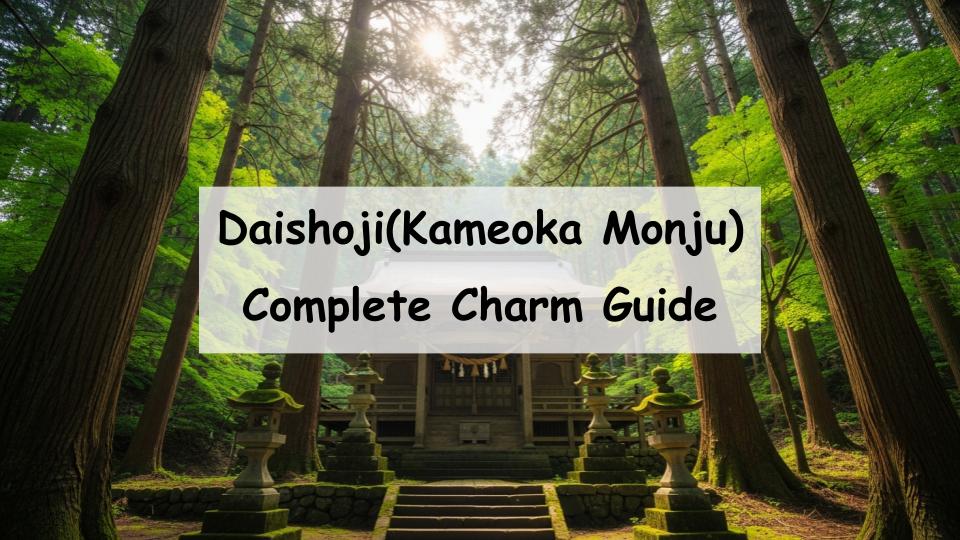
“I want to visit the strongest god of learning in Yamagata Prefecture.”
“What are the must-see spots at Daisho-ji (Kameoka Monju)?”
Daisho-ji (大聖寺), located in Takahata Town, Yamagata Prefecture, is a famous “power spot” visited by people from all over the country praying for success in exams and academic achievement. However, for first-time visitors, there may be many things you want to know in advance, such as specific benefits, highlights within the temple grounds, and how to get there.
To give you the conclusion first: Daisho-ji is a historic temple counted as one of “Japan’s Three Monju,” and it is full of sights worth seeing, such as the “Rikonsui” (water that bestows wisdom) and the solemn Monju Hall.
In this article, we will introduce everything from basic information like the history and benefits of Daisho-ji (Kameoka Monju), to the must-see highlights of the grounds, and detailed access methods by car or train. Reading this before you visit will definitely help you appreciate the charm of Daisho-ji even more.
- What is “Daisho-ji (Kameoka Monju),” One of Japan’s Three Monju?
- Not Just for Passing Exams! 5 Must-See Highlights of Daisho-ji
- For Proof of Worship! Daisho-ji’s Goshuin, Amulets, and Famous Gourmet
- Access to Daisho-ji (Kameoka Monju) and Parking Information
- Surrounding Sightseeing Spots to Visit with Daisho-ji
- Summary
- A Message from the Guide
What is “Daisho-ji (Kameoka Monju),” One of Japan’s Three Monju?
Daisho-ji, enshrined in Takahata Town, Yamagata, is affectionately known as “Kameoka Monju” and is a famous temple bustling with many worshipers. First, let’s explain its distinguished history and benefits.
Famous Benefits as the God of Learning and 1,200 Years of History
Daisho-ji is counted as one of Japan’s Three Monju, alongside “Kireto no Monju” in Kyoto and “Abe no Monju” in Nara. Since it enshrines Monju Bosatsu (Manjusri Bodhisattva), who governs wisdom, it is said to have immense benefits for academic achievement and passing exams. During exam season, many students and families visit from both inside and outside the prefecture.

Its history is ancient, said to have been founded by the high priest Tokuitsu Shonin in the 2nd year of the Daido era (807 AD). It began when the high priest, impressed by the mountain’s resemblance to Mount Wutai in China, enshrined Monju Bosatsu there. It has attracted faith for over 1,200 years since then.

A Historic Temple Worshipped by Date Masamune and Naoe Kanetsugu
Daisho-ji has deep ties to historical figures. During the Warring States period, Date Masamune, known as the “One-Eyed Dragon,” is said to have visited and dedicated a Chinese poem to the temple.
Additionally, Naoe Kanetsugu, a senior vassal of Uesugi Kagekatsu famous for his “Love” (Ai) helmet, also loved this place. In the 7th year of the Keicho era (1602), Kanetsugu hosted a grand poetry gathering (Kameoka Hyakushu), gathering many warlords and literary figures, including Maeda Keiji. In this way, it is a high-ranking temple that has been revered by many intellectuals and military commanders since ancient times.
Not Just for Passing Exams! 5 Must-See Highlights of Daisho-ji
The temple grounds are dotted with buildings that convey history and power spots with mysterious legends. Here are 5 points you must stop by when visiting.
The Main Hall “Monju-do” with a Solemn Atmosphere
At the top of the stone steps of the approach appears the main hall, “Monju-do,” which is the center of Daisho-ji. The dignified wooden building harmonizes with the surrounding cedar grove, creating a solemn atmosphere.
The principal image of Monju Bosatsu is enshrined inside the hall, and numerous votive tablets are hung on the ceiling and pillars. If you put your hands together in prayer within the silence, you will feel a refreshing sense of your mind being cleansed.
“Rikonsui” Famous Water That Bestows Wisdom When Drunk
Behind the main hall (to the back right), there is a spring called “Rikonsui” (Water of Sharpness/Intelligence). This water has long been worshipped as “Wisdom Water,” and legend says that drinking just one sip will bestow the wisdom of Monju.
The cold, clear water not only quenches the thirst of worshipers but also has a refreshing quality that seems to clear the head. When you visit, be sure to drink this famous water and share in its benefits.
“Sixteen Arhat Statues” and “Nio Gate” Standing on the Stone Paved Approach
The approach leading from the parking lot to the main hall is also a highlight. At the entrance stands the “Nio Gate” guarded by powerful Vajra warrior statues, marking the entry into the sacred area.
As you walk along the stone-paved path surrounded by rows of cedar trees, the “Sixteen Arhat Statues” standing on mossy rocks welcome worshipers. The Arhats, each with a different expression, are atmospheric and make you feel the weight of long history.
“En-musubi Kannon,” a Hidden Power Spot for Matchmaking
Daisho-ji is famous as a god of learning, but it is actually also a power spot for matchmaking (En-musubi). In the “Kannon-do” hall to the right of the main hall, 33 Kannon statues are enshrined and are affectionately known as the En-musubi Kannon.
Many people wishing for good matches or couples visit here, making it a recommended spot for those who want to deepen relationships in love or friendship, not just academics.

“Daikokuten” Divination by Weight to See if Wishes Come True
In the precincts, there is a statue of Daikokuten, also called “Living Daikoku” or “Running Daikoku.” This Daikoku statue has a mysterious legend: you can divine whether your wish will come true by making a wish and then lifting the statue to feel its weight.
It is said that if you think “Become light” and it feels light when you lift it, your wish will be granted; conversely, if it feels heavy, more effort is needed. Why not try lifting it yourself and experiencing the divine favor?
For Proof of Worship! Daisho-ji’s Goshuin, Amulets, and Famous Gourmet
Don’t forget to check out Goshuin (red seal stamps) and souvenirs for memories of your visit. Here we introduce special items and famous gourmet food available only here.
Types of Goshuin Available at Daisho-ji (Paper Cutouts, Limited Editions, etc.)
At Daisho-ji, in addition to the regular Goshuin with powerful brushstrokes, beautiful paper cutout (Kirie) Goshuin and limited-edition Goshuin may be awarded depending on the season. The paper cutout Goshuin with delicate craftsmanship are very popular and perfect as a commemoration of your visit. You can either have your Goshuin book signed or receive a pre-written paper, so please check at the reception office.
“Wisdom Pencils” and Passing Exam Goods Popular with Students
A classic souvenir for students is the “Wisdom Pencil.” These pencils, said to house the wisdom of Monju, will be a strong ally on the day of the exam. In addition, there is a wide variety of items specialized for academic achievement, such as amulets for passing exams and Ema (votive pictures).

Fun After Worship! Famous “Tama Konnyaku”
After finishing your worship, it is recommended to taste Yamagata’s famous “Tama Konnyaku” (round konjac balls) sold at the stalls on the approach or in the precincts. The piping hot konjac, thoroughly soaked in soy sauce flavor, permeates a body tired from walking. Eating it with a little mustard is simple but offers an exquisite taste.
Access to Daisho-ji (Kameoka Monju) and Parking Information
Since Daisho-ji is located halfway up a mountain, it is reassuring to check access methods in advance.
Access by Car and Free Parking Location
If accessing by car, it takes about 15 minutes from the “Nanyo-Takahata IC” on the Tohoku-Chuo Expressway. From the center of Takahata Town, follow the guide signs along the prefectural road for a smooth drive.
There is a free parking lot near the entrance to the approach, capable of holding several dozen cars. However, it gets very crowded during New Year’s, exam season, and the annual festival, so we recommend visiting with plenty of time to spare.
Access by Train and Taxi
If using public transportation, the nearest station is “Takahata Station” on the JR Yamagata Shinkansen/Ou Main Line. Since it is a long distance from the station to Daisho-ji, walking is difficult.
It is common to take a taxi from Takahata Station, which takes about 10 minutes. There is a taxi stand in front of the station, so if you tell the driver “To Kameoka Monju,” you will arrive without getting lost.
Surrounding Sightseeing Spots to Visit with Daisho-ji
Takahata Town has attractive sightseeing spots other than Daisho-ji. If you have time, be sure to extend your trip.
“Akutsu Hachiman Shrine” with a Beautiful Three-Storied Pagoda
“Akutsu Hachiman Shrine,” located about 15 minutes by car from Daisho-ji, is known for having the only three-storied pagoda in the prefecture. The contrast between the pagoda and the seasonal scenery, such as cherry blossoms in spring and autumn leaves in fall, is breathtaking, making it a popular spot for photography.
The Fantastical Rock Wall “Uriwari Sekitei Park”
“Uriwari Sekitei Park” is a park developed from the site of a Takahata stone quarry. The huge rock walls rising vertically are full of impact, creating a fantastical space that looks like ancient ruins. It is a hidden gem where you can enjoy rock tunnels and unique landscapes.
Summary
Daisho-ji (Kameoka Monju), one of Japan’s Three Monju, is a historic temple with 1,200 years of history and a powerful spot for academic achievement and passing exams. From the solemn Monju Hall to the wisdom-bestowing Rikonsui water and the unique Daikokuten weight divination, the grounds are full of highlights.
There are also plenty of joys to be had, such as beautiful paper cutout Goshuin and the famous Tama Konnyaku. When you visit Yamagata, why not make a trip to Daisho-ji and receive the wisdom and power of Monju-sama?
A Message from the Guide

Although it is difficult to reach without a car, it is a quiet temple that cleanses the soul.


Comment