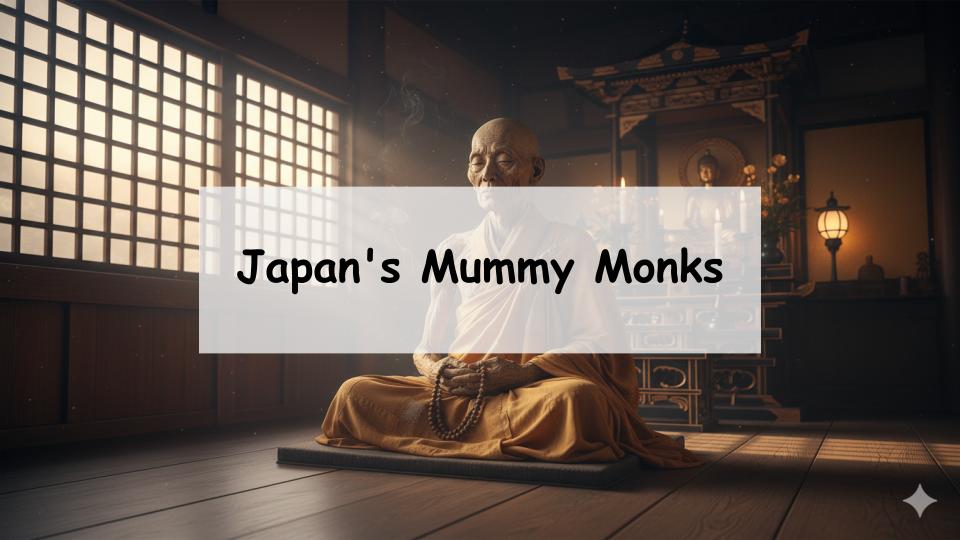
When you hear the word “Sokushinbutsu,” what image comes to mind? Many people likely hold questions such as “Why would someone choose to become a mummy after severe ascetic training?” or “Where in Japan can I go to see them?” mixed with feelings of awe and perhaps a little fear.
To state the conclusion first, Sokushinbutsu are not merely mummies but the revered figures of monks who entered eternal meditation after unimaginable asceticism to save people suffering from famine and disease. Even today, it is possible to actually view their miraculous forms at specific temples, primarily in Yamagata Prefecture.
In this article, we will explore the historical background of how Sokushinbutsu came to be and the truth behind these “mummified Buddhas,” while strictly selecting and introducing five temples across the country where they are enshrined. We will also explain points to note when visiting and the characteristics of each temple, so please use this as preparatory knowledge before visiting the sites.
- What is Sokushinbutsu? The Truth and History of Japan’s “Mummified Buddhas”
- The Grueling Process to Become Sokushinbutsu and its “Mysteries”
- 5 Major Temples Where Sokushinbutsu are Enshrined [Visitor Information Included]
- Manners and Points to Note When Visiting Sokushinbutsu Temples
- Summary
- A Message from the Guide
What is Sokushinbutsu? The Truth and History of Japan’s “Mummified Buddhas”
Sokushinbutsu in Japan refers to more than just the state of a preserved body; it is deeply connected to Buddhist faith. We will explain why monks chose to leave their physical bodies behind, the spirituality behind that background, and the differences from general mummies.
Definition of Sokushinbutsu and the Desire for Salvation
Sokushinbutsu refers to monks who entered the earth alive after severe training and remained in this world in a mummified state. This is considered neither an act of suicide nor a longing for death, but an ultimate form of asceticism undertaken to take on the suffering of sentient beings (the people) and continue saving them for eternity.
Especially in eras when famine and epidemics were rampant, the strong spirit of compassion to pray for the peace of the world and the happiness of people by sacrificing one’s own body was the driving force. It is believed that they did not die but are still in a state of deep meditation, watching over people.
The Decisive Difference Between General Mummies and Sokushinbutsu
There is a decisive difference in the creation process between mummies discovered around the world and Japanese Sokushinbutsu. General mummies, such as those in Egypt, are bodies that have been artificially processed and preserved after death by removing organs and using preservatives. This is a wish for the resurrection of rulers or peace in the afterlife and can be said to be a passive process.
On the other hand, Sokushinbutsu involves the monks themselves undergoing severe training such as dietary restrictions while alive, transforming their bodies into a state capable of preservation through their own will and power. It is an active process of modifying the body while alive rather than a treatment performed after death, and in this respect, Sokushinbutsu can be said to be an extremely rare existence globally.
The Grueling Process to Become Sokushinbutsu and its “Mysteries”
To become a Sokushinbutsu, a preparation period requiring patience and years beyond the imagination of ordinary people is necessary. Let us look at the fierce content of the training to change the constitution from before death so that the body does not decay.
“Mokujikigyo” to Reduce Body Fat and Moisture to the Limit
The first step a monk aiming for Sokushinbutsu takes is a dietary restriction called “Mokujikigyo” (wood-eating training). This involves abstaining from five grains such as rice and wheat, and sustaining life by eating only tree nuts, grass, and tree bark found in the mountains.
The purpose of this training is to strip away body fat and moisture to the absolute limit, preventing bacteria from breeding and causing decay after death. It is also said that they sometimes drank lacquer sap to increase the antiseptic effect within the body. Through this training, which spans thousands of days, the monk’s body approaches a state of skin and bones while still alive.
“Dochunyujo” to Enter a Box Alive and Offer Eternal Prayer
When the body is prepared through Mokujikigyo, the monk finally proceeds to “Dochunyujo” (entering the earth). The monk enters a stone chamber or wooden coffin buried about three meters underground and sits in meditation with hands clasped in prayer. Only a bamboo tube for air is passed through the coffin, and the monk continues to chant sutras while ringing a bell.
The disciples on the ground confirm the master is alive while the sound of the bell can be heard, and when the sound stops, they pull out the bamboo tube and seal it. Then, after three years and three months (one thousand days) have passed, the coffin is dug up, and if the body remains without decaying, it is enshrined as a Sokushinbutsu. Through this process, they become eternal Buddhas.
5 Major Temples Where Sokushinbutsu are Enshrined [Visitor Information Included]
Currently, there are over a dozen Sokushinbutsu that can be viewed in Japan, and many of them are concentrated in the Shonai region of Yamagata Prefecture. Here, we introduce five representative temples where you can actually meet Sokushinbutsu.
[Yamagata] Yudono-san Sohon-ji Dainichibo (Shinnyokai-shonin)
At Yudono-san Sohon-ji Dainichibo in Tsuruoka City, Yamagata Prefecture, the Sokushinbutsu of “Shinnyokai-shonin” is enshrined. Shinnyokai-shonin entered the earth at the advanced age of 96, and he is worshipped by many people for his deeds during his lifetime and his high virtue.
Dainichibo is one of the centers of Sokushinbutsu faith, and you can receive a polite explanation from the temple staff during your visit. Also, a ritual to change his robes is held regularly, and amulets containing a piece of that cloth are sought after by many worshippers.
[Yamagata] Churenji (Tetsumonkai-shonin)
At Churenji in Tsuruoka City, Yamagata Prefecture, just like Dainichibo, “Tetsumonkai-shonin” is enshrined. Tetsumonkai-shonin is said to have been from a samurai background, and he was a monk with such fierce spirit and compassion that there is an anecdote that he gouged out his own left eye and offered it to the river god to save the common people from hardship.
Cultural properties such as ceiling paintings are also one of the highlights, and the temple is known as a setting for movies and novels. It is a place where you can feel the powerful way of life of Tetsumonkai-shonin.
[Yamagata] Kaikoji (Chukai-shonin, Enmyokai-shonin)
Kaikoji in Sakata City, Yamagata Prefecture, is an extremely rare temple in Japan where two Sokushinbutsu are enshrined. “Chukai-shonin” and “Enmyokai-shonin” are enshrined side by side in the same hall.
You can witness the miracle of two monks who lived in different eras becoming Sokushinbutsu with the same aspiration. Access from the city is relatively good, and the environment is easy to visit.

[Niigata] Saishoji (Kochi-hoin)
At Saishoji in Nagaoka City, Niigata Prefecture, “Kochi-hoin,” considered the oldest Sokushinbutsu in Japan, is enshrined. It is said that he entered the earth during the Kamakura period, and his historical value is immeasurable.
The Sokushinbutsu of Kochi-hoin is also known for being in a very good state of preservation. The temple itself is located in a quiet place surrounded by deep forest, and you can feel the weight of faith that has continued since ancient times.
[Gifu] Yokokuraji (Myoshin-shonin)
At Yokokuraji in Ibigawa Town, Gifu Prefecture, the Sokushinbutsu of “Myoshin-shonin” is enshrined. Myoshin-shonin originally entered the earth at Mt. Mishotai in Yamanashi Prefecture, but due to the influence of the anti-Buddhist movement in the Meiji era, he came to be enshrined at the current Yokokuraji.
This Sokushinbutsu has an extremely well-preserved body, and medical investigations have been conducted on it. Yokokuraji is a famous temple also called the “Shosoin of Mino” and is famous for its autumn leaves, but the figure of Myoshin-shonin quietly sitting in the treasure hall leaves a strong impression on visitors.
Manners and Points to Note When Visiting Sokushinbutsu Temples
Sokushinbutsu are the principal images of temples or objects of faith themselves. There are manners and points to note that you should know to worship with respect, rather than viewing them with a sightseeing mood.
Photography Rules and Mindset During Worship
Basically, photography of Sokushinbutsu is prohibited at almost all temples. This is not only for the protection of cultural properties but also because Sokushinbutsu are objects of faith and the revered forms of deceased monks.
When entering the hall, remove your hat and act quietly. When you proceed in front of the Sokushinbutsu, first clasp your hands in prayer, bow, and express your respect in your heart. Acts such as making noise out of curiosity or tapping on the glass case are strictly prohibited. If there is an explanation by a monk, please listen quietly.
Advance Confirmation of Winter Closures and Access Difficulty
Many temples where Sokushinbutsu are enshrined are located in mountainous areas or regions with heavy snowfall. Especially around Mt. Yudono in Yamagata Prefecture, the snow is deep during winter, and there are cases where the temple itself closes or suspends visitor reception.
Also, since many places have very few public transport services, moving by car, taxi, or rental car is recommended in most cases. When planning a visit, be sure to check the temple’s official website or call in advance to confirm the open periods, hours, and access methods.
Summary
Sokushinbutsu are the ultimate form of compassion of monks who sacrificed their own bodies to save people’s suffering. Their forms, left behind after grueling Mokujikigyo and Dochunyujo, go beyond mere material existence as mummies and convey a strong spiritual message to the present day.
You can actually view them at temples mainly in Yamagata Prefecture, as well as in Niigata and Gifu, but when visiting, it is important not to forget respect for them as holy sites, not just tourist spots. A journey to touch the existence of “Sokushinbutsu,” woven by history and faith, will surely leave something deep in your heart.
A Message from the Guide
Viewing them after learning the background and history offers a completely different perspective.
Comment