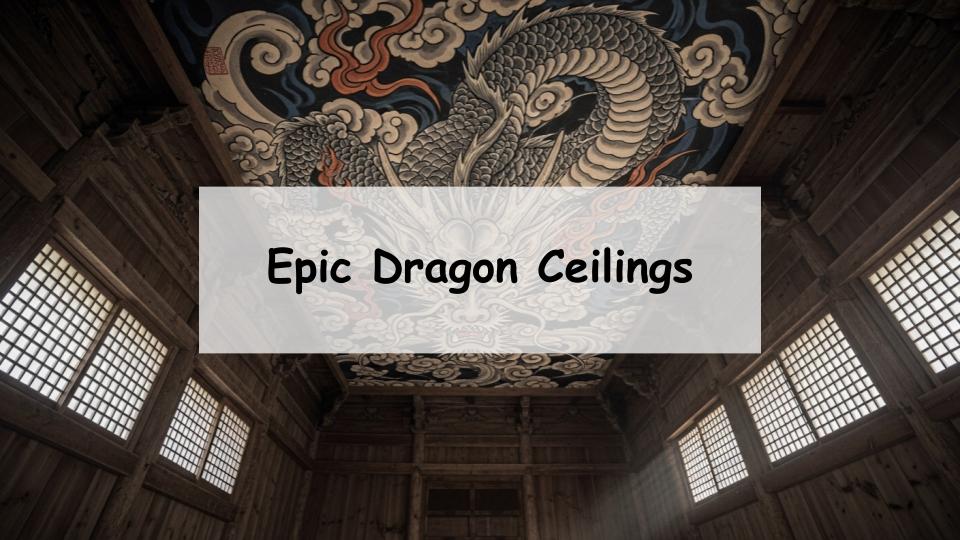
Have you ever stepped into the main hall of a temple, looked up, and been captivated by a giant dragon or vibrant paintings spreading across the ceiling?
“I want to see a powerful ceiling painting in person.”
“Where exactly are the temples famous for Cloud Dragon paintings?”
Many people looking for their next temple destination likely have these questions. Japan is dotted with temples boasting historically significant and overwhelming ceiling paintings. In particular, the “Happo-nirami no Ryu” (Dragon Glaring in Eight Directions), which appears to meet your gaze from any angle, is a sight you must see at least once in your life.
In this article, we have selected 7 famous temples with impressive “Cloud Dragon” paintings that you should visit. We will explain the features and highlights of each temple to help you plan your next trip.
- What are “Cloud Dragon Paintings”? Why Dragons are Painted in Temples
- [Kyoto] 5 Famous Temples with Impressive Cloud Dragon Paintings
- Kennin-ji “Twin Dragons” | A Masterpiece by Junsaku Koizumi Celebrating 800 Years
- Tenryu-ji “Cloud Dragon” | A Dynamic Dragon by Matazo Kayama
- Myoshin-ji “Cloud Dragon” | A Masterpiece by Tan’yu Kano (Important Cultural Property)
- Shokoku-ji “Banryu-zu” | By Mitsunobu Kano, The “Roaring Dragon” that Echoes
- Nanzen-ji “Cloud Dragon” | Powerful Brushstrokes by Meiji Master Keinen Imao
- [Kanto] 2 Famous Temples with Historic Cloud Dragon Paintings
- Points and Manners to Enjoy Ceiling Paintings
- Summary
- A Message from the Guide
What are “Cloud Dragon Paintings”? Why Dragons are Painted in Temples
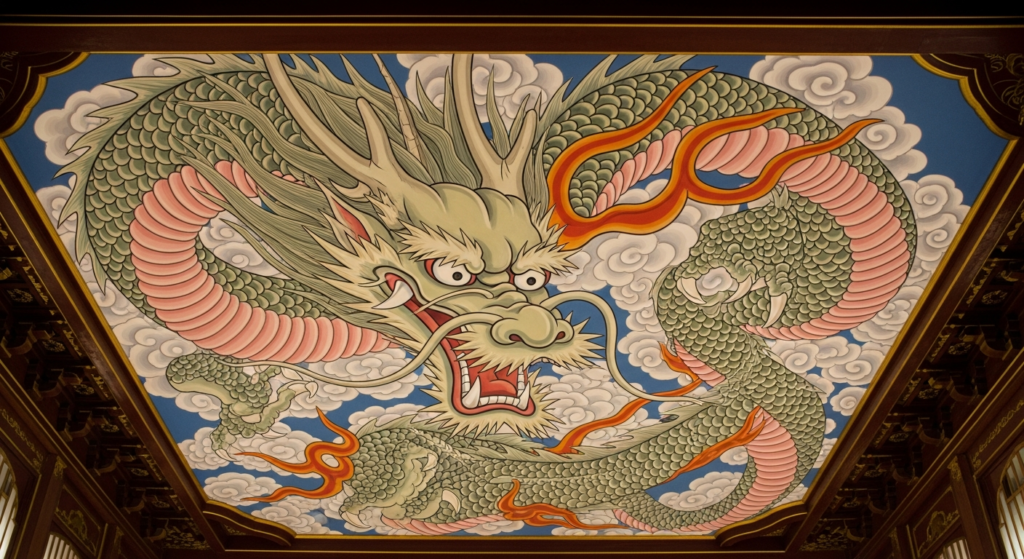
When you look up at the ceiling of a temple’s Dharma Hall (Hatto) or Main Hall (Hondo), you will often see a powerful image of a dragon. These are called “Unryuzu” (Cloud Dragon Paintings) and have played an important role in many temples, especially those of the Zen sect. They are not merely decorations; they carry deep religious meanings and the prayers of our ancestors.
The Role of Dragons in Buddhism and Protection of the “Dharma”
In Buddhism, the dragon is positioned as one of the Eight Legions protecting the Buddhist law (Dharma). Dragons are imaginary divine beasts believed to control water. In Japan, where wooden architecture has traditionally been dominant, fire was one of the most feared disasters. Therefore, by painting a dragon that summons water on the ceiling—which acts as the roof of the building—prayers for “fire protection” were imbued to save the temple from flames. Additionally, it signifies the “Rain of Dharma” (teachings of Buddha) falling from the heavens upon the monks, and these paintings have been adopted to watch over them during their strict training.
The Overwhelming “Glaring in Eight Directions” and “Roaring Dragon” Tricks
Cloud Dragon paintings on ceilings often feature various tricks to surprise worshipers. A representative technique is called “Happo-nirami” (Glaring in Eight Directions). This is painted so that no matter where you stand in the hall, you feel as though the dragon is looking directly at you. This provides a sense of security that you are being watched over by the Buddha’s law, while simultaneously imparting a lesson that your actions are always being observed.
Another famous phenomenon is the “Nakiryu” (Roaring Dragon) or “Crying Dragon.” When you clap your hands beneath the dragon’s face, the sound reflects multiple times between the ceiling and the floor, creating a mysterious sound that echoes as if the dragon were crying out. These experiences that appeal to both sight and sound are the true thrill of viewing ceiling paintings.
[Kyoto] 5 Famous Temples with Impressive Cloud Dragon Paintings
The ancient capital of Kyoto is home to many historic Zen temples, each possessing unique ceiling paintings. Here, we introduce five temples with overwhelmingly powerful Cloud Dragon paintings that you should stop by when sightseeing in Kyoto.
Kennin-ji “Twin Dragons” | A Masterpiece by Junsaku Koizumi Celebrating 800 Years
In the Dharma Hall of Kennin-ji, known as the oldest Zen temple in Kyoto, there is a “Twin Dragons” painting featuring two dragons intertwined with mouths open (Ah) and closed (Un). This is a relatively new work created in 2002 to commemorate the 800th anniversary of Kennin-ji’s founding, painted by Japanese artist Junsaku Koizumi over a period of about two years. While Cloud Dragon paintings typically feature a single dragon, the sight of two dragons dancing across the entire ceiling is a masterpiece.
A Grand Scale Equivalent to 108 Tatami Mats
The most distinctive feature of these “Twin Dragons” is their overwhelming size. The dimensions are 11.4 meters vertically and 15.7 meters horizontally, covering an area equivalent to approximately 108 tatami mats. It was created in the gymnasium of a closed elementary school in Hokkaido and transported to Kyoto after completion. When you enter the Dharma Hall and look up, you can experience the massive dragons closing in on you, a scale so grand it will leave you speechless.

Tenryu-ji “Cloud Dragon” | A Dynamic Dragon by Matazo Kayama
On the ceiling of the Dharma Hall at the World Heritage site Tenryu-ji in Arashiyama, there is a “Cloud Dragon” painted by the master of Japanese painting, Matazo Kayama. This work was created in 1997 to commemorate the 650th anniversary of the passing of Muso Kokushi, the founder of Tenryu-ji. The dragon, painted within a circle with a diameter of 9 meters, effectively uses not only ink shading but also blue and gold, characterized by a modern and dynamic expression. This painting also employs the “Happo-nirami” technique, and as you move while looking up, you can experience the strange sensation of the dragon’s sharp gaze following you wherever you go.

Myoshin-ji “Cloud Dragon” | A Masterpiece by Tan’yu Kano (Important Cultural Property)
The ceiling painting in the Dharma Hall of Myoshin-ji was painted by Tan’yu Kano, who was active in the early Edo period. This Cloud Dragon painting, said to have taken 8 years to complete, is designated as an Important Cultural Property. It is painted directly onto a mirror ceiling with a diameter of 12 meters, conveying the soul of the artist from that era to the present day. This dragon has also been loved as a “Dragon Glaring in Eight Directions” because its expression seems to change depending on the viewing position and angle. From one angle it appears to be ascending to the heavens, and from another, it looks as if it is descending to strike prey; its figure possesses a power that seems to see through the viewer’s heart.
Shokoku-ji “Banryu-zu” | By Mitsunobu Kano, The “Roaring Dragon” that Echoes
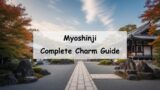
The “Banryu-zu” (Coiled Dragon) in the Dharma Hall of Shokoku-ji was painted by Mitsunobu Kano, the eldest son of Eitoku Kano. The ceiling painting here is widely known as a “Nakiryu” (Roaring Dragon) where the sound echoes when you clap your hands in a specific spot. Standing on the mark on the floor of the hall and clapping once, a lingering “Bin” sound rains down from the ceiling. This mysterious tone, likened to the cry of a dragon, is due to the special curved structure of the hall. It is a valuable spot where you can have a religious experience through sound, not just visual beauty.

Nanzen-ji “Cloud Dragon” | Powerful Brushstrokes by Meiji Master Keinen Imao
On the ceiling of the Dharma Hall at Nanzen-ji, also famous for its autumn leaves, is a “Cloud Dragon” painted by the Japanese painter Keinen Imao, who was active from the Meiji to Taisho periods. This dragon, called the Hanryu, was created to coincide with the reconstruction of the Dharma Hall in the 42nd year of the Meiji era (1909). Compared to Cloud Dragon paintings in other Zen temples, it features the realistic and powerful brushwork typical of Meiji period works. In the dim hall, the appearance of the dragon emerging from the clouds with its striking black ink commands a quiet but intense dignity, encouraging worshipers to straighten their posture.

[Kanto] 2 Famous Temples with Historic Cloud Dragon Paintings
It is not only Kyoto that has magnificent ceiling paintings; the Kanto area also has temples with wonderful works. Here, we introduce famous spots in Kamakura and Nikko that you should visit at least once.
Kencho-ji “Cloud Dragon” | Viewing Junsaku Koizumi’s Grand Work in Kamakura’s Representative Zen Temple
In the Dharma Hall of Kencho-ji, which boasts the highest rank among the Five Mountains of Kamakura (Kamakura Gozan), a “Cloud Dragon” is painted by Junsaku Koizumi, the same artist as the Twin Dragons of Kennin-ji. This work, created to commemorate the 750th anniversary of Kencho-ji’s founding, boasts a huge size of 10 meters vertically and 12 meters horizontally. Unlike the Twin Dragons of Kennin-ji, this painting depicts a single dragon trying to grasp a jewel with powerful claws, and its figure with five claws gives a sense of high status, symbolizing the emperor. Looking up at the dragon in the serene atmosphere of Kamakura leaves a deep impression on the viewer.
Nikkozan Rinno-ji Yakushido “Roaring Dragon” | A Mystical Experience of Bell-like Sounds
In the Yakushido Hall of Nikkozan Rinno-ji, located right next to Nikko Toshogu Shrine, there is a “Nakiryu” (Roaring Dragon) painted by Yasunobu Kano (Eishin). The Roaring Dragon here is characterized by a clear sound like a rolling bell ringing “Kiin” that echoes for a long time when you strike the hyoshigi (wooden clappers) under the dragon’s head. Although named because it sounds like a dragon’s cry, it is actually due to an acoustic effect where the curvature of the cypress boards on the ceiling resonates the sound. Looking up at the beautiful ceiling painting while listening to that mysterious tone will surely be one of the highlights of your Nikko sightseeing.

Points and Manners to Enjoy Ceiling Paintings
If you are going all the way to see ceiling paintings, you want to fully enjoy their charm. Here, we explain points to check before visiting and manners to observe at the site.
Check Viewing Times and “Special Opening” Periods in Advance
Depending on the temple, the Dharma Hall or Main Hall may not be open to the public at all times. Especially for buildings with ceiling paintings, it is not uncommon for them to be “specially opened” only during the spring and autumn tourist seasons. Also, viewing may not be possible during times when ceremonies or memorial services are being held. When planning your trip, it is important to check the official website for opening periods and visiting hours to target a time when you can definitely see them.
Photography Rules and Etiquette
Many people may want to capture the power of the ceiling paintings in photos. However, many temples prohibit photography inside the halls from the perspective of protecting cultural properties and because they are places of faith. Even if photography is permitted, the use of flash is strictly prohibited as it can damage the paintings. Furthermore, lying on the floor to look up at the ceiling or speaking loudly is a violation of manners. At the site, please follow the instructions of signs and staff, and strive to appreciate the art with a quiet heart.
Summary
The ceiling paintings remaining in temples across Japan are not just beautiful works of art, but spatial arts imbued with deep prayers for fire protection and the guardianship of Buddhist law. The power of the “Glaring in Eight Directions” seen at Kennin-ji and Tenryu-ji in Kyoto, and the mysterious tone of the “Roaring Dragon” that can be experienced at Shokoku-ji and Nikkozan Rinno-ji, are moving experiences that can only be tasted by visiting in person. Why not visit the temples introduced this time and immerse yourself in the magnificent worldview spreading above your head?
A Message from the Guide
Photos just don’t do them justice. The power is on a whole other level in person.


Comment