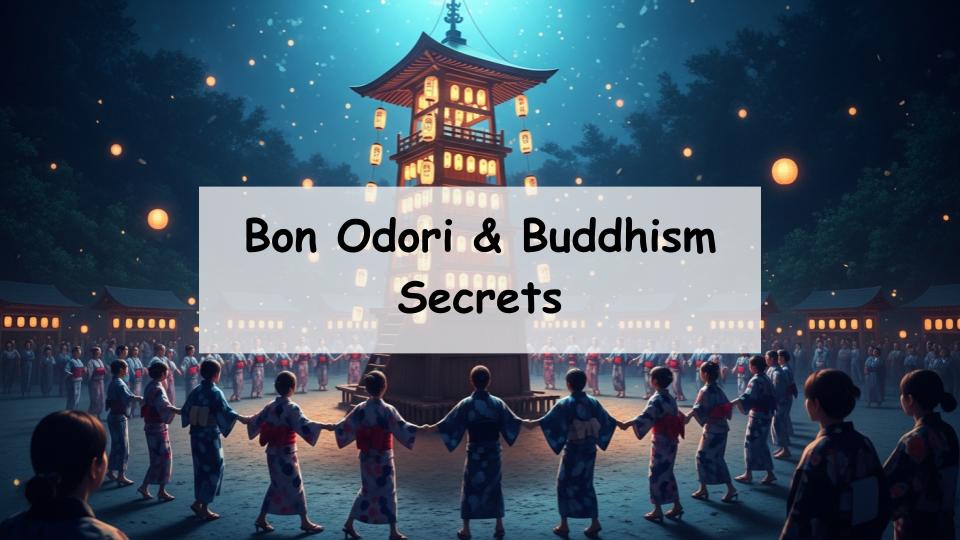
Bon Odori (Bon Dance) is a beloved tradition at summer festivals and community events in Japan. While many people enjoy imitating the moves and dancing along, have you ever wondered, “Why do we dance in the first place?” or “What does this have to do with Buddhism?”
Actually, Bon Odori is not just summer entertainment; it carries significant meaning as a Buddhist ritual to comfort and honor the spirits of ancestors.
In this article, we will focus on three key points to explain the surprising roots of Bon Odori, its deep relationship with Buddhism, and the prayers embedded in each dance movement. Knowing the original meaning will surely make this year’s Bon Odori a much deeper and more profound experience for you.
- What is Bon Odori? Its Surprisingly Unknown Connection to Buddhism [Point 1: Origins]
- The Purpose of Bon Odori is “Memorial Service” and “Joy” [Point 2: Purpose]
- The Buddhist Meanings Hidden in the Yagura and the Circle [Point 3: Form]
- Buddhist Influences Seen in Japan’s Three Great Bon Odori
- Enjoying Modern Bon Odori with Deeper Understanding
- A Message from the Guide
What is Bon Odori? Its Surprisingly Unknown Connection to Buddhism [Point 1: Origins]
While Bon Odori colors the Japanese summer, exploring its origins reveals a history deeply intertwined with Buddhism. Here, we explain how Bon Odori was born and how it evolved into its current form.
The Roots lie in the Heian Period’s “Nenbutsu Odori”
The origin of Bon Odori is said to be the “Nenbutsu Odori” (Chanting Dance) started by Kuya Shonin in the Heian period. To spread the chanting of the Nenbutsu (Buddhist prayer) to the common people, Kuya Shonin adopted a method of dancing rhythmically while beating bells and drums. This unique style was embraced by the people of that time and spread along with Buddhist teachings. This is considered the oldest form of the modern Bon Odori.

The Fusion of Ippen Shonin’s “Odori Nenbutsu” and Ullambana
In the Kamakura period, Ippen Shonin spread “Odori Nenbutsu” (Dancing Nenbutsu) while traveling across the country. This practice, which involved entering a state of religious ecstasy by dancing while chanting, attracted many commoners. When this dancing practice combined with “Urabon-e” (Ullambana)—the Buddhist event for honoring ancestral spirits—the prototype of the current Bon Odori was formed. Faith and folk traditions merged, becoming established in local communities.
Its Position within the Buddhist Event of “Obon”
In Buddhism, “Obon” (officially Urabon-e) is the period when ancestral spirits return to this world. The Bon Odori performed during this time is positioned not merely as entertainment, but as an important ritual to welcome, entertain, and honor these returning spirits. In other words, Bon Odori has played the role of a sacred time where the living and the dead interact.
The Purpose of Bon Odori is “Memorial Service” and “Joy” [Point 2: Purpose]
Bon Odori is considered to have two main purposes. One is a memorial service (Kuyo) for the deceased, and the other is joy (Kanki) for their salvation. Let’s look at the meaning of each in detail.
A Ritual to Comfort and Send Off Ancestral Spirits
One of the fundamental purposes of Bon Odori is to comfort the ancestral spirits who have returned home during Obon. Lively dancing is meant to please the spirits, and towards the end of Obon, it also signifies sending them back to the other world. In some regions, the custom of dancing while chanting prayers remains strong, specifically as a memorial for those experiencing their first Obon after passing (Hatsubon).
Expressing the Joy of Salvation from Hell
The other important meaning is “Joy.” This relates to the story of Maudgalyayana (Mokuren), a disciple of Buddha, which is the origin of Obon. The story goes that Maudgalyayana saved his deceased mother, who was suffering in the realm of Hungry Ghosts, by making offerings according to Buddha’s teachings. It is said that Bon Odori began when Maudgalyayana danced with joy upon learning that his mother was released from suffering and ascended to heaven. Thus, Bon Odori embodies the physical expression of joy that prayers have been answered.
Does it Mean “Dancing with the Dead”?
There is also a belief that the spirits returning for Obon join the circle of the dance. Costumes that cover the face, such as deep woven hats or towels, are seen in some regions; it is said this is to blur the distinction between the living and the dead, or to make it easier for the deceased to join the circle. It is a place to dance not only with the living but also with those who have passed away, enjoying a temporary reunion.
The Buddhist Meanings Hidden in the Yagura and the Circle [Point 3: Form]
The Yagura (tower) seen at Bon Odori venues and the shape of the circle formed by participants actually hide Buddhist meanings. Deep prayer and faith are reflected even in these casual forms.
Why Clockwise? The Reason for Dancing in a Circle
In many Bon Odori dances, participants form a circle and move clockwise. This is believed to be based on the Buddhist etiquette of “Unyo” (circumambulation). Unyo is a manner of showing respect by walking around a Buddha statue or pagoda to the right. Additionally, the circular shape symbolizes “perfection” or “enlightenment” and represents the harmony and equality of the group.
The Yagura is a “High Seat” Where Deities Descend
The Yagura assembled in the center of the square is not just a stage for the singers and musicians. It serves as a vessel (yorishiro) for gods and Buddhas to descend upon and carries the meaning of a “Koza” (high seat) from which sermons are delivered. The Yagura towering in the center acts as a pillar connecting this world and the next, and dancing to the rhythm emanating from it has been thought of as communicating with deities and spirits.
Prayers Embedded in Hand Movements and Footsteps
While many Bon Odori choreographies mimic agricultural movements, some include gestures with Buddhist meanings. For example, movements resembling pressing hands together represent Gassho (prayer), and reaching hands toward the sky can express seeking salvation or offering prayers. Furthermore, the action of stomping strongly on the ground is said to have the meaning of calming the spirits of the earth or suppressing evil spirits.
Buddhist Influences Seen in Japan’s Three Great Bon Odori
Japan has diverse Bon Odori dances, but the “Three Great Bon Odori” each possess unique histories and Buddhist backgrounds. Here are their characteristics.
Awa Odori (Tokushima Prefecture): Inheriting the Frenzy of Nenbutsu Odori
Tokushima’s Awa Odori is known for its energetic dancing, but its origins are partly rooted in spirit dances and Nenbutsu Odori. Famous for the phrase “The dancing fool and the watching fool,” it historically had strong elements of “Furyu Odori” (group procession dances). The enthusiastic, chaotic dancing can be seen as conveying the state of selflessness and religious elation found in Ippen Shonin’s Odori Nenbutsu to the modern day.
Nishimonai Bon Odori (Akita Prefecture): Shades of the “Dance of the Dead”
The Nishimonai Bon Odori in Akita Prefecture is characterized by its elegant and fantastical atmosphere. In particular, dancers wearing “Hikosa hoods”—black hoods that reveal only the eyes—are referred to as performing the “Dance of the Dead.” This is a valuable example that strongly retains the aspect of Bon Odori as a memorial for the deceased, representing the dead dancing mingled among the living.
Gujo Odori (Gifu Prefecture): All-Night Dancing During Obon
Gujo Odori in Gifu Prefecture is held over a long period, but during the four days of Obon, “Tetsuya Odori” (all-night dancing) takes place. During this time, people dance wholeheartedly until morning for the memorial of their ancestors. In the Edo period, since it was permitted to dance without regard to social status (Bureiko), it became a place where community unity was strengthened and the enthusiasm of the Buddhist event reached its peak.
Enjoying Modern Bon Odori with Deeper Understanding
By knowing the history and Buddhist background of Bon Odori, it becomes more meaningful for us today. Finally, here is how to enjoy modern Bon Odori.
Deepening Community Ties While Preserving Tradition
Modern Bon Odori functions not only as a religious event but also as a place to strengthen community bonds. Inheriting local traditional dances leads to protecting the region’s identity. By dancing in the same circle across generations, you can deepen exchanges with people you might not interact with otherwise.
A Sense of Oneness from Dancing with Heart
It is more important to dance with your heart than to dance skillfully. By dancing with gratitude to ancestors and awareness of harmony with those around you, you can feel a mysterious sense of unity and refreshment. Letting your body move to the sound of drums and the rhythm of the folk songs allows for a time of “no-mind,” serving as a great opportunity to forget daily stress and cleanse the spirit.
Manners and Clothing when Participating
When participating in Bon Odori, following the rules of the organizers and the community is the first priority. While Yukata is the standard attire, clothes that are easy to move in are often acceptable. However, remembering that it is a Buddhist event, it is safer to avoid overly revealing clothing. Also, when entering the dance circle, try not to disrupt the flow; wait for the right timing and follow the person in front of you. Participating with respect ensures that everyone can enjoy the Bon Odori pleasantly.
A Message from the Guide
Learning about this history makes me want to go see Bon Odori festivals all over Japan.



Comment