If you are visiting Onomichi City in Hiroshima Prefecture, Senkoji Temple (Senkoji) is a tourist spot you absolutely cannot miss.
However, when planning your actual trip, you might find yourself asking questions like:
- “What are the main attractions and blessings at Senkoji?”
- “It’s on a mountain, so should I take the ropeway or walk?”
- “I want to know about gourmet food and sightseeing routes nearby!”
To give you the conclusion first: Senkoji Temple is the highlight of Onomichi tourism, fusing “panoramic views of the Seto Inland Sea” with a “spiritual power spot woven from giant rocks.” You simply cannot talk about Onomichi without visiting this place.
In this article, we will explain everything in detail, from the history of Senkoji and its must-see highlights (giant rocks, the main hall, and scenic spots) to the best ways to get there so you won’t get lost.
Read this guide to get all the information you need to fully enjoy the charm of Senkoji Temple and make your trip to Onomichi the best it can be.
- [Hiroshima/Onomichi] What kind of temple is Senkoji? History and Features
- Spectacular Views and Power Spots! 5 Must-See Highlights of Senkoji
- The “Main Hall (Red Hall)” Built on a Stage Structure with a View of the Onomichi Channel
- Mysterious Giant Rock Groups “Tama no Iwa” and “Kagami Iwa” with Legends
- Thrilling! “Ishizuchi Mountain Chain Training” Climbing the Rocky Mountain
- The Bell Tower Chosen as One of the “100 Soundscapes of Japan”
- “Path of Literature” Lined with Stone Monuments Loved by Many Writers
- Blessings, Goshuin, and Omamori (Charms) Information at Senkoji
- Access to Senkoji: Ropeway or Walking?
- Nearby Sightseeing Spots to Visit with Senkoji
- Basic Information about Senkoji (Hours, Fees, Address)
- A Message from the Guide
[Hiroshima/Onomichi] What kind of temple is Senkoji? History and Features
Senkoji Temple is a Shingon sect temple beloved as the symbol of Onomichi City, Hiroshima. Located halfway up Mt. Senkoji at an altitude of about 140 meters, it stands as if watching over the town of Onomichi. Here, we explain the long history of Senkoji and its unique location.
A Historic Temple Said to be Founded by Kobo Daishi
The history of Senkoji is very old. It is said to have been founded by Kobo Daishi (Kukai) in the first year of the Daido era (806). Later, in the mid-Heian period, it was restored by Tada no Manju (Minamoto no Mitsunaka) and has gathered the faith of many people up to the present day. Stone structures and buildings from various eras remain within the precincts, allowing you to feel the weight of history accumulated over many years. In particular, the layout of the temple grounds utilizing natural giant rocks retains traces of ancient mountain worship, giving visitors a mysterious impression.

A Perfect Location Overlooking the Onomichi Townscape and the Seto Inland Sea
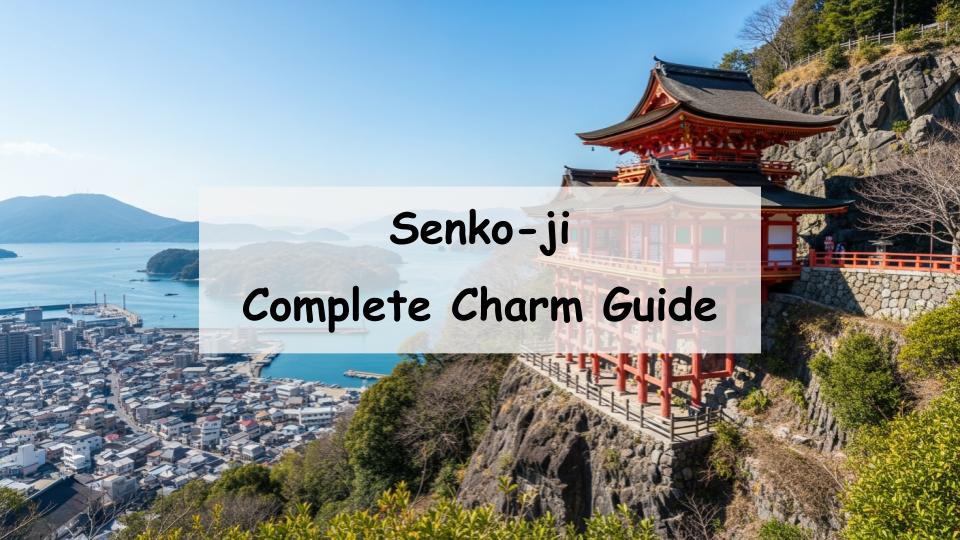
The greatest feature of Senkoji is its overwhelming location. Because it is built clinging to a steep cliff, the temple grounds offer a panoramic view of the miniature garden-like townscape of Onomichi, the calm Seto Inland Sea, and islands such as Mukaishima. It is popular as a cherry blossom spot in spring and a night view spot in the evening, offering beautiful scenery regardless of the time or season. This spectacular view is one of the reasons why Senkoji is called the highlight of Onomichi tourism.
Spectacular Views and Power Spots! 5 Must-See Highlights of Senkoji
Although the precincts of Senkoji are not very large, the highlights are concentrated. Here are five points you must see when visiting.
The “Main Hall (Red Hall)” Built on a Stage Structure with a View of the Onomichi Channel
The vividly vermilion-colored Main Hall, also known as the “Red Hall,” is characterized by its stage construction style (similar to Kyoto’s Kiyomizu-dera) that juts out over the sheer cliff. From this stage, you can enjoy a panoramic view of the Onomichi Channel spreading out below and the ferries coming and going. The Main Hall houses the hidden Buddhist statue of the Thousand-Armed Kannon Bodhisattva, which is unveiled to the public once every 33 years. The contrast between the vermilion hall, the blue sky, and the sea makes for excellent photos.
Mysterious Giant Rock Groups “Tama no Iwa” and “Kagami Iwa” with Legends
There are many giant and strange rocks on Mt. Senkoji, each with its own mysterious legend. The huge round rock next to the Main Hall is called “Tama no Iwa” (Jewel Rock). Legend has it that a shining gem was once placed on top of this rock, serving as a lighthouse to illuminate the sea at night. Also, “Kagami Iwa” (Mirror Rock), which has a surface as flat as a mirror, is said to have reflected light in the old days, making it a spot where you can feel mysterious power. These giant rock groups tell the story of Senkoji being a place of ancient rock worship.
Thrilling! “Ishizuchi Mountain Chain Training” Climbing the Rocky Mountain
On the rock walls of the precincts, there is a chain training site for “Ishizuchi Mountain,” known as a training ground for Shugendo (mountain asceticism). Here, you can actually experience climbing the rocky mountain using chains hanging down the rock face. When you climb to the top, there is a small shrine, and the view from there is exceptional. If you are confident in your physical strength, please give it a try.
How to Experience Chain Training and Precautions
To experience the chain training, you must offer a donation before attempting it. Since you will be climbing a nearly vertical rock wall, clothes that allow easy movement and non-slip shoes are essential. Attempting this in skirts or heels is extremely dangerous and should be avoided. Also, please note that it may be closed during rainy weather or when the rocks are wet and slippery. Please consult your own physical strength and experience it within a reasonable range.
The Bell Tower Chosen as One of the “100 Soundscapes of Japan”
Along with the Main Hall, the Bell Tower standing on the cliff is a symbol of Senkoji. The sound of the bell ringing from here is loved by the citizens of Onomichi as the “Bell of Time” and has been selected by the Ministry of the Environment as one of the “100 Soundscapes of Japan to Preserve.” It is crowded with many worshippers during the New Year’s Eve bell ringing, and its tone echoes throughout the town of Onomichi, further enhancing the atmosphere of the old city.
“Path of Literature” Lined with Stone Monuments Loved by Many Writers
The promenade leading from Senkoji Park to Senkoji Temple is maintained as the “Path of Literature” (Bungaku no Komichi). Here, 25 natural stone literary monuments are dotted around, engraved with the works of writers and poets associated with Onomichi, such as Shiga Naoya, Hayashi Fumiko, and Masaoka Shiki. It is a cultural spot where you can think about the scenes of Onomichi loved by literary figures while strolling down the path that winds through giant rocks and pine trees in the dappled sunlight.
Blessings, Goshuin, and Omamori (Charms) Information at Senkoji
Historic Senkoji is also known as a power spot that grants various wishes. Here we introduce the blessings, charms, and Goshuin (temple stamps).
Main Blessings: Matchmaking, Warding Off Evil, Exam Success, etc.
The principal image, the Thousand-Armed Kannon, is said to have been made by Prince Shotoku and is believed to grant various wishes. It is particularly famous for blessings in matchmaking (en-musubi), conception, family safety, passing exams, and warding off evil. Also, the “Kachi Kachi Prayer Beads” in the precincts are popular with worshippers; it is said that by turning the large beads, you can banish worldly desires and wish for happiness.
Popular “Rilakkuma Ema” and a Wide Variety of Charms
At the amulet reception office of Senkoji, a wide variety of charms are available. Of particular note are the Ema (votive tablets) and charms in collaboration with the popular character “Rilakkuma.” In addition to traditional charms, these cute items are available, making them popular with younger generations of worshippers. Of course, traditional items such as matchmaking charms and gourd-shaped charms for warding off evil are also well-stocked.
Types of Goshuin Available and Reception Location
Goshuin can be obtained at the Nokyo-jo (stamp office) near the Main Hall. Basically, Goshuin for the principal image “Senju Kannon” and “Kobo Daishi” are available. Since it is also a pilgrimage site for the Setouchi 33 Kannon Pilgrimage and the Chugoku 33 Kannon Pilgrimage, they also cater to pilgrims. It is recommended to bring your Goshuin book (Goshuin-cho) and have it inscribed as a memory of your trip.
Access to Senkoji: Ropeway or Walking?
Access to Senkoji, located halfway up the mountain, can be roughly divided into three methods: ropeway, walking, and car. Each method has its merits, but we will introduce the recommended routes according to your sightseeing style.
[Classic] Enjoy an Aerial Walk on the “Senkoji Mt. Ropeway”
The most common and recommended method for enjoying the scenery is to use the “Senkoji Mt. Ropeway.” You can enjoy an aerial walk of about 3 minutes from the Sanroku Station (bottom) to the Sancho Station (top), and the gondola offers a view of the Onomichi townscape and the Seto Inland Sea. Since the uphill slopes in Onomichi are steep, a route where you take the ropeway up to the summit and then walk down while visiting Senkoji is physically easier and allows for efficient sightseeing.
Ropeway Fees, Operating Hours, and Boarding Location
The ropeway boarding point is at “Sanroku Station.” It is accessible by bus or on foot from JR Onomichi Station. Operating hours are usually from 9:00 AM to 5:15 PM, running at 15-minute intervals. There are one-way and round-trip fares, but if you plan to walk down, purchase a one-way ticket.
[Walk] The Route Climbing Through “Cat Alley”
For those confident in their physical strength or those who want to enjoy the atmosphere of the back alleys, access on foot is also possible. The route called “Cat Alley” (Neko no Hosomichi) is particularly popular. Along the way, you will find cat art called “Fukuishi Neko” (Lucky Stone Cats) and old folk house cafes, creating a retro and mysterious space typical of Onomichi. Although slopes and stairs continue, you can climb while slowly enjoying the scenery.
[Car] Parking Information and Precautions During Congestion
If you access by car, use the “Senkoji Park Parking Lot” near the summit. However, the road to the parking lot is a mountain road, and it can be very congested with traffic jams during the tourist season and weekends. Since it often becomes full, it is often smoother to park your car in a parking lot at the foot of the mountain and access by ropeway or on foot if possible.
Nearby Sightseeing Spots to Visit with Senkoji
Here are some sightseeing spots located right nearby that you should visit along with your worship at Senkoji.
The Renewed Senkoji Park “PEAK” Observation Deck
The observation deck located in the summit area, further up from Senkoji, was renewed in 2022 and reborn as “PEAK.” It features a design like a long, thin bridge with a total length of about 63 meters. It is barrier-free, allowing anyone to easily enjoy a 360-degree grand panorama. The sunset and night view seen from here are simply breathtaking.
Onomichi City Museum of Art Designed by Tadao Ando
The “Onomichi City Museum of Art” located inside Senkoji Park is known for being designed by the world-famous architect Tadao Ando. It is a beautiful museum where the main building, which is a renovated historic building, and the new building with a novel design are fused. It is also famous for the heartwarming “battle” between the security guard and a cat trying to enter, which became a hot topic on social media. You can enjoy the calm atmosphere along with art appreciation.
Basic Information about Senkoji (Hours, Fees, Address)
Finally, here is the basic information you need when visiting Senkoji.
There are generally no restrictions on the time you can enter the temple grounds for worship. However, the reception hours for charms and the stamp office are usually from 9:00 AM to 5:00 PM. Admission to the temple grounds is free, but some experiences such as the special viewing of the Main Hall or the chain training require a fee. The address is 15-1 Higashitsuchido-cho, Onomichi City, Hiroshima Prefecture. We recommend checking the official website for the latest information before visiting.
A Message from the Guide
The area around Onomichi Station is beautiful, and there are many temples near Senkoji Temple, so I highly recommend it as a travel destination.

Comment