Have you ever visited a Japanese temple and noticed a tower with a unique silhouette—a square first floor and a round second floor? You might have wondered, “What is this mysterious building?” or “How is it different from a standard five-story pagoda?”
This structure is known as a Tahoto (Prabhutaratna Pagoda), a beautiful style of Buddhist pagoda that evolved uniquely in Japan. While its shape may look whimsical at first glance, it actually conceals important messages representing the worldview of Esoteric Buddhism and deep spiritual meaning.
In this article, we will unravel the mysteries of the Tahoto through “5 Keys,” ranging from basic knowledge of its structure to its origins and interesting Buddhist significance. By the time you finish reading, you will surely look forward to spotting a Tahoto on your next journey.
- What is a Tahoto? Structure and Features of the “Two-Story” Tower [Key 1]
- Origins and History: The Background of Japan’s Unique Evolution [Key 2]
- Buddhist Meaning and Worldview Embedded in the Tahoto [Key 3]
- Differences from 5-Story and 3-Story Pagodas [Key 4]
- Must-See! National Treasure Class Tahoto in Japan [Key 5]
- Summary: Knowing the Meaning of Tahoto Deepens Your Temple Visits
- A Message from the Guide
What is a Tahoto? Structure and Features of the “Two-Story” Tower [Key 1]
Among temple architecture, the Tahoto stands out due to its distinctive structure. First, let’s look at the basic mechanics of the Tahoto that can be understood from its exterior.
Square Below, Round Above? The Secret of its Shape
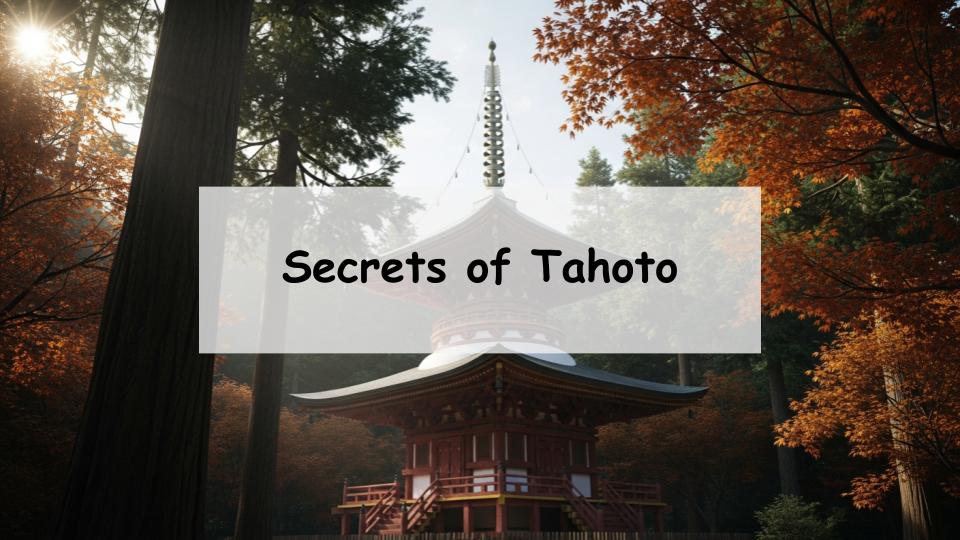
When you look at a Tahoto from the front, the lower level (first floor) is square. Above that sits a white, dome-shaped mound called the Kamebara (turtle belly), and on top of that rests a square roof. This geometric combination of square and circle is a unique feature found only in Tahoto, not in other standard pagodas.
While many people perceive it as a two-story tower, the interior is often a single open space (an atrium). Structurally, it is sometimes treated as a single-story building. The connection between the square base and the round upper section creates a graceful curve reaching toward the sky, which is part of its charm.
The Roof Shape and the Role of the “Mokoshi”
Another element that defines the Tahoto’s appearance is the layering of its roofs. At a glance, it looks like a two-story pagoda because there are two roofs. However, the lower roof is technically a Mokoshi (skirt roof), which acts as a decorative penthouse or lean-to.
This Mokoshi stabilizes the balance of the entire building and protects the core structure from rain and wind. The upper roof is pyramidal (Jewel style), and its peak is adorned with a metal ornament called a Sorin. The stacking of the square skirt roof, the round dome, and the square upper roof creates the beautiful, geometric proportion of the Tahoto.
Origins and History: The Background of Japan’s Unique Evolution [Key 2]
Why was such a uniquely shaped tower created? Tracing its roots leads us to Buddhist scriptures and key figures in Japanese history.
Originating from the “Many Treasures Tathagata” in the Lotus Sutra
The name “Tahoto” comes from Taho Nyorai (Prabhutaratna), a Buddha who appears in the Lotus Sutra. In the “Apparition of the Jeweled Stupa” chapter of the sutra, it is said that while Shakyamuni Buddha was preaching, a gigantic tower suddenly emerged from the earth and floated in the air.
Inside the tower sat Taho Nyorai, who appeared to prove that Shakyamuni’s teachings were the truth. Legend says he invited Shakyamuni to sit beside him inside the tower. The Tahoto began as an attempt to visualize this dramatic scene, making it a piece of architecture that gives form to a Buddhist miracle.

Kukai (Kobo Daishi) and the Establishment of Tahoto in Esoteric Buddhism
The form of the Tahoto we see in Japan today is said to have been established by Kukai (Kobo Daishi) in the early Heian period. When spreading the teachings of Esoteric Buddhism brought back from Tang China, Kukai placed great importance on the Tahoto as a symbol to visually convey the profound worldview of the religion.
Although the earliest towers have been lost, the “Daito” (Great Pagoda) that Kukai planned at Koyasan became the prototype for the Tahoto in Japan. It subsequently spread to Esoteric temples across the country. In other words, the Tahoto is a unique form of Buddhist architecture perfected by Japanese sensibility while incorporating continental culture.

Buddhist Meaning and Worldview Embedded in the Tahoto [Key 3]
The Tahoto is not just a building; it is a device that represents vast Buddhist teachings. Here, we unravel the religious significance embedded in the tower.
The Tower Itself Represents a “Mandala”
In Esoteric Buddhism, the “Mandala”—which charts the truth of the universe and the state of enlightenment—is crucial. The Tahoto functions as a “Three-Dimensional Mandala.” The square lower level is often interpreted as representing the earthly world or compassion, while the round upper level represents the heavenly world or the wisdom of enlightenment.
The entire building expresses the world of the Buddha. It is designed so that worshippers can intuitively grasp Buddhist truths that cannot be fully explained in words, simply by looking up at the tower.

The Central Buddha and the Connection to Dainichi Nyorai
Inside a Tahoto, the central figure of Esoteric Buddhism, Dainichi Nyorai (Mahavairocana), or the Five Wisdom Buddhas, is usually enshrined. Dainichi Nyorai is considered the fundamental Buddha of the universe, and by being placed in the center of the tower, it symbolizes that this tower is the center of the cosmos.
Furthermore, the Shinbashira (heart pillar) that supports the tower is sometimes viewed as the spine or symbol of Dainichi Nyorai himself. The interior pillars and walls are often painted in rich colors, creating a space that, when the doors are opened, reveals a glimpse of the Pure Land or the world of enlightenment.
Differences from 5-Story and 3-Story Pagodas [Key 4]
Temples often have Five-Story or Three-Story Pagodas in addition to Tahoto. What exactly makes them different? Here are the points to distinguish them.
Definitive Structural Difference: Number of Layers and Shape
The most obvious difference is the silhouette. Five-story and three-story pagodas generally have square layers that are uniform in shape, stacked regularly on top of one another. In contrast, the Tahoto has the dynamic “square below, round above” shape mentioned earlier.
If you see a white, dome-like bulge (Kamebara) under the roof from a distance, it is definitely a Tahoto. Also, while standard pagodas are high-rise structures (three or five layers), the Tahoto is basically a two-layered structure.

Difference in Role: Relics of Buddha vs. Esoteric Worldview
Originally, a pagoda (stupa) served as a grave to house the Buddha’s relics (ashes). Five-story and three-story pagodas strongly retain this traditional meaning and are typically built as monuments to honor Shakyamuni Buddha.
On the other hand, while the Tahoto is a type of pagoda, in Esoteric Buddhism, it carries a strong meaning as the “Palace where Dainichi Nyorai resides” or the “Realm of Truth” itself. While the five-story pagoda acts as a “monument for worship,” the Tahoto emphasizes its character as a “space to experience the worldview of the teachings.”
Must-See! National Treasure Class Tahoto in Japan [Key 5]
Finally, here are three representative pagodas in Japan that you should visit to experience the beauty of the Tahoto. All are designated as National Treasures.
Ishiyamadera Tahoto (Shiga Pref.): The Oldest and Most Elegant
The Tahoto at Ishiyamadera in Otsu City, Shiga Prefecture, is said to have been donated by Minamoto no Yoritomo and is the oldest existing Tahoto. It retains the architectural style of the Kamakura period, and its well-balanced proportions are praised as the “most beautiful Tahoto in Japan.” The cypress bark roof, which carries the weight of history, harmonizes perfectly with the surrounding nature.

Kongobuji (Wakayama Pref.): The Great Stupa, Symbol of Koyasan
The “Konpon Daito” (Fundamental Great Stupa) at Koyasan in Wakayama Prefecture is the origin of the Tahoto concept envisioned by Kukai. With an overwhelming height of about 48.5 meters, its vivid vermilion exterior captivates visitors. Inside, a world of three-dimensional Mandalas expands, allowing you to physically feel the energy of this sacred Esoteric site.

Negoroji Daito (Wakayama Pref.): Japan’s Largest Wooden Tahoto
The Great Stupa (Daito) at Negoroji in Iwade City, Wakayama Prefecture, boasts the largest size among wooden Tahoto in Japan. Designated as a National Treasure, it is also a witness to history, having survived the wars of the Sengoku period. You can even find bullet marks from matchlock guns on the surface of the tower, offering a sense of historical drama alongside architectural beauty.
Summary: Knowing the Meaning of Tahoto Deepens Your Temple Visits
The Tahoto is not merely an old building with an unusual shape. Its unique form condenses the ancient people’s “longing for truth” and their “cosmic view.”
By understanding the meaning behind the combination of the square and the circle, as well as the historical background, the scenery you casually look at will appear completely different. On your next temple visit, please stop in front of a Tahoto and try to feel the profound world it represents.
A Message from the Guide

Understanding the historical background makes visiting temples a much more fulfilling experience.


Comment