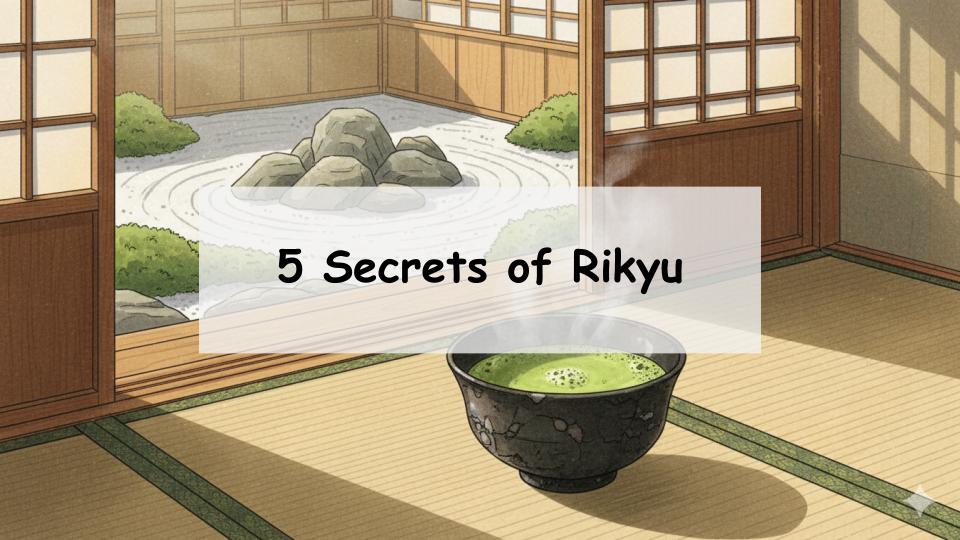
“What kind of philosophy is hidden in the tea ceremony perfected by Sen no Rikyu?”
“What is the connection between the spirit of the tea ceremony and Buddhism?”
Have you ever wondered this while exploring history and Japanese culture?
To get straight to the point, the profound teachings of Buddhism, especially Zen, breathe at the core of the “Wabi-sabi” aesthetic and the manners of the tea ceremony pursued by Sen no Rikyu. In other words, understanding Buddhist philosophy is essential to grasping Rikyu’s true intentions.
In this article, we will unravel the “5 hidden secrets” of Sen no Rikyu’s tea ceremony and clearly explain its deep relationship with Buddhism, which greatly influenced his thought.
By reading this, you will gain a clear understanding of the worldview Rikyu idealized and the essence of the Way of Tea that is still passed down today. Please read to the end and touch the profound world of the tea ceremony and Buddhism.
- Who Was Sen no Rikyu? The Historical Background Where the Tea Ceremony and Buddhism Intersect
- 5 Hidden Secrets of Sen no Rikyu’s Tea Ceremony! The Influence of Buddhist Philosophy
- Secret 1: The “Nijiriguchi” Reflecting the Buddhist Idea of Equality
- Secret 2: The State of Nothingness Embedded in “Wabi-sabi”
- Secret 3: “Ichi-go Ichi-e” and the Buddhist Concept of Impermanence
- Secret 4: The Simplicity and Fortitude Embodied by the “Kuro Raku” Tea Bowl
- Secret 5: The “Roji” (Tea Garden) Representing the Pure Land of Buddha
- The Buddhist Heart Residing in Rikyu’s “Wa-Kei-Sei-Jaku”
- Conclusion: Discovering the Depth of Buddhism Through Sen no Rikyu’s Tea Ceremony
Who Was Sen no Rikyu? The Historical Background Where the Tea Ceremony and Buddhism Intersect
The Life of Sen no Rikyu and the Establishment of “Wabi-cha”
Sen no Rikyu was a tea master who flourished from the Sengoku (Warring States) period to the Azuchi-Momoyama period. Born in the prosperous merchant town of Sakai, he devoted himself to the Way of Tea from a young age. At the time, the mainstream tea ceremony style was lavish, showing off expensive Chinese tea utensils. However, Rikyu came to value spiritual richness over such material wealth. He perfected “Wabi-cha,” finding beauty in everyday, ordinary utensils and simple spaces, thereby revolutionizing Japanese aesthetics.
Training at Daitokuji Temple and the Teaching of “Cha-Zen Ichimi”
Behind the establishment of Rikyu’s Wabi-cha lay his deep Buddhist faith. Rikyu underwent strict Zen training at Daitokuji, a Rinzai Zen temple in Kyoto. Through this training, he reached the state of “Cha-Zen Ichimi,” the realization that making tea and practicing Zen are essentially the same. The act of deeply facing one’s inner self in the minimal space of a tea room was exactly like Zen meditation. Rikyu’s tea ceremony transcended mere etiquette or entertainment, elevating into a place of spiritual cultivation embodying Buddhist teachings.
5 Hidden Secrets of Sen no Rikyu’s Tea Ceremony! The Influence of Buddhist Philosophy
Secret 1: The “Nijiriguchi” Reflecting the Buddhist Idea of Equality
A Tea Room Design That Eliminates Social Hierarchy
The “Nijiriguchi” (crawling-in entrance), said to be devised by Sen no Rikyu, is designed so small that an adult must crouch to enter. This tiny entrance embodies the Buddhist concept that all things are equal. No matter how high-ranking a samurai might be, he had to remove his sword and lower his head to enter the tea room. It reflects Rikyu’s strong belief in stripping away worldly decorations like power and social status at the door, treating everyone as equals inside the tea room.
Secret 2: The State of Nothingness Embedded in “Wabi-sabi”
The Aesthetic of Subtraction Linked to Zen Teachings
The spirit of “Wabi-sabi,” synonymous with Sen no Rikyu, is deeply tied to the state of nothingness highly valued in Zen Buddhism. The aesthetic of subtraction—stripping away unnecessary ornamentation and finding beauty in imperfection and the passage of time—is exactly the Buddhist teaching of letting go of material attachment. Rikyu believed that precisely because a state is simple and empty, one can sense the spiritual richness filling it.
Secret 3: “Ichi-go Ichi-e” and the Buddhist Concept of Impermanence
Embracing Transience by Cherishing the Present Moment
The famous phrase “Ichi-go Ichi-e” (one time, one meeting), which expresses the mindset of the tea ceremony, is also based on Buddhist teachings. At its core is the truth of impermanence, meaning that all phenomena in this world are constantly changing. Recognizing deeply that today’s tea gathering is a once-in-a-lifetime encounter that will never be repeated, participants act with utmost sincerity toward each other. Rikyu conveyed through the tea ceremony a way of life that maximizes the value of the present moment precisely because the world is impermanent.
Secret 4: The Simplicity and Fortitude Embodied by the “Kuro Raku” Tea Bowl
The Zen Spirit of Avoiding Flamboyance
The black Raku tea bowls that Rikyu had artisans fire appear modest and rugged at first glance. Stripped of all decoration, these pitch-black bowls were the exact opposite of the brightly colored Chinese bowls popular at the time. This design expresses the Zen spirit of demanding that one solely face one’s inner self without being distracted by outward splendor. The shape that fits comfortably in the hand and the deep black color serve both to highlight the vivid green of the whisked matcha and to guide the mind toward tranquility.
Secret 5: The “Roji” (Tea Garden) Representing the Pure Land of Buddha
A Space to Purify the Mind Away from the Secular World
The garden leading to the tea room is called the “Roji,” but it is not a mere pathway. For Sen no Rikyu, the Roji was a Buddhist training ground for brushing off the dust of the secular world and regaining a pure heart. The series of actions—walking among lush trees stepping on stones and purifying one’s hands and mouth at the stone basin—is a process of purifying one’s own mind. By passing through the Roji, people are freed from daily worldly thoughts and can head into the tea room with a pure mind akin to the Buddha’s Pure Land.
The Buddhist Heart Residing in Rikyu’s “Wa-Kei-Sei-Jaku”
The Meaning of Harmony, Respect, Purity, and Tranquility and Their Connection to Zen
The spirit of Sen no Rikyu’s tea ceremony is encapsulated in the four characters “Wa-Kei-Sei-Jaku.” “Wa” means harmony, uniting hearts to spend time peacefully together. “Kei” means having deep respect for everything, including the guests and utensils. “Sei” refers to maintaining purity not only in the visible space but also within one’s mind. Finally, “Jaku” points to a quiet, unshakable mind that remains calm in any situation. All of these perfectly align with the goals of Zen training, which seek to remove the boundaries between self and others and pursue inner peace.
What We Can Learn from Sen no Rikyu’s Philosophy Today
In our modern society, overflowing with information and constantly changing, the philosophy Rikyu derived from Buddhism holds great significance. Rather than just pursuing material wealth, we need time to intentionally pause, strip away the unnecessary, and reexamine ourselves. The Zen spirit breathing in Sen no Rikyu’s tea ceremony provides hints for calming the minds of stressed modern people and finding modest beauty and a sense of gratitude in everyday life.
Conclusion: Discovering the Depth of Buddhism Through Sen no Rikyu’s Tea Ceremony
The tea ceremony established by Sen no Rikyu was not simply a set of manners for enjoying drinking tea. From the structure of the Nijiriguchi to the selection of tea utensils, and down to its spirituality, everything is deeply rooted in Buddhist teachings, particularly Zen. Unraveling the hidden secrets of Sen no Rikyu’s tea ceremony is equivalent to touching the profound philosophy of Buddhism itself. By understanding the historical background and the true intentions he embedded, you should be able to appreciate just how spiritually rich the uniquely Japanese culture of the tea ceremony truly is.

Comment