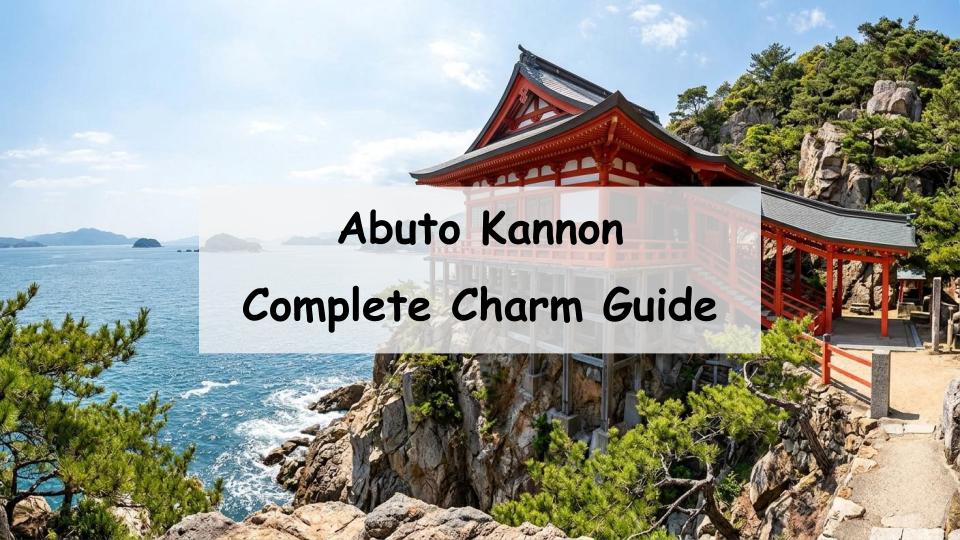
Perched precariously at the southern tip of the Numakuma Peninsula in Fukuyama City, Hiroshima Prefecture, Abuto Kannon (officially named Bandaiji Temple) commands a striking presence. For centuries, this sacred site has been revered as a sanctuary for maritime safety, smooth childbirth, and fertility.
My visit here wasn’t meticulously planned. While driving along the coastal road, I happened to spot it on Google Maps and wondered, “Wait, is there really a temple sitting right on the edge of the sea?” Intrigued, I immediately took a detour.
Following the map to a small parking area near the shore, I strolled up the coastal trail. What awaited me at the end of the path was a dramatic, breath-taking scene.
- My Experience: The Atmosphere and Unmatched Ocean Views
- The Sacred Presence: Encountering the Main Deity
- Highlights & Architectural Wonders of Abuto Kannon
- The Peaceful Coastal Approach
- Bandaiji Guest Hall (Prefectural Important Cultural Property)
- The Vermilion Covered Staircase
- The Main Hall of Kannon (National Important Cultural Property)
- Thrilling Overhanging Veranda and Low Railings
- The Unique “Oppai Ema” (Votive Tablets for Childbirth & Fertility)
- The Ashizuri Stone Tower at the Tip
- Practical Visitor Guide: Sect, Hours, Fees & Access
- Final Thoughts
My Experience: The Atmosphere and Unmatched Ocean Views
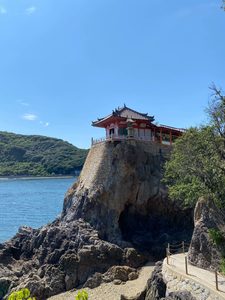
Walking past the main precinct toward the cliff’s edge, the vast, deep blue waters of the Seto Inland Sea suddenly opened up before me. Clinging tightly to the rugged, craggy rocks stood the vibrant vermilion Hall of Kannon.
“Wow, this literally looks like a painting…” I found myself muttering out loud.
This iconic landscape was famously depicted in Utagawa Hiroshige’s ukiyo-e woodblock print series Pictures of Famous Places in the 60-odd Provinces, as well as Naoya Shiga’s famous novel A Dark Night’s Passing. Even today, the view has lost none of its magic. The refreshing sea breeze, the sound of waves crashing against the rocks, and the contrast between green pine trees and bright red architecture create an unforgettable, atmospheric moment.
The Sacred Presence: Encountering the Main Deity
As a fan of Buddhist statues, my usual routine involves standing in awe before a statue, examining every detail—from the gentle facial expressions to the delicate drapery of the robes.
However, at Abuto Kannon, I have to be completely honest: the sheer drama of the architecture and its surrounding environment completely overpowered the impression of individual statues.
The temple houses a statue of Eleven-Headed Kannon (Ekadasamukha), watching over the safety of travelers and the prayers of visitors. Yet, here, the “deity” feels larger than the altar inside. The entire hall—standing fearlessly on a sheer cliff and opening out into the boundless sea—feels like a physical manifestation of Kannon’s pure land (Fudaraku).
It offers a rare, immersive type of spiritual experience where you absorb the Buddhist worldview through the atmosphere of the entire space rather than just contemplating a sculpture.
Highlights & Architectural Wonders of Abuto Kannon
Here is a detailed look at the key architectural features and points of interest along the visiting route.
The Peaceful Coastal Approach
Leaving the free parking area near the shore, you begin your walk along a quiet approach shaded by pine trees and stone paths. As you step closer to the cliffs, the noise of daily life fades away, replaced by the calming sound of the ocean.
Bandaiji Guest Hall (Prefectural Important Cultural Property)
Before reaching the cliffside hall, you will pass the Guest Hall (Kyaku-den). Designated as an Important Cultural Property of Hiroshima Prefecture, this structure is a fine example of Momoyama-style Zen Abbot’s Quarters (Hojo) featuring an irimoya (hip-and-gable) roof style. In contrast to the dynamic cliffside hall, its warm wood tones and elegant proportions create a serene, grounded atmosphere.
The Vermilion Covered Staircase
After touring the Guest Hall, you head toward the main sanctuary via a covered wooden staircase built along the steep slope. Step by step, surrounded by vermilion pillars, the sound of wind and waves intensifies, heightening your anticipation.
The Main Hall of Kannon (National Important Cultural Property)
The absolute highlight of the temple is the Hall of Kannon, extending directly over the waves on a timber framework set into the rock face. Originally established in the 10th century, the current hall was rebuilt in the 1570s by the powerful warlord Mori Terumoto and is designated as a National Important Cultural Property. The harmonious blend of Japanese architectural styles against the raw cliff faces is truly majestic.
Thrilling Overhanging Veranda and Low Railings
Walking around the outer wooden corridor (en interior) surrounding the hall is the most thrilling part of the visit. The floorboards are intentionally built with a slight outward slope toward the ocean, and the handrails are surprisingly low—reaching only around knee-to-waist height! Stepping onto the edge, your vision drops directly into the swirling waters below. Even if you aren’t afraid of heights, your feet might tingle with excitement. Make sure to wear shoes with good grip and watch your footing.
The Unique “Oppai Ema” (Votive Tablets for Childbirth & Fertility)
Inside the hall, the walls are covered with unique wooden votive tablets shaped like breasts, known locally as Oppai Ema. Abuto Kannon has long been revered by women praying for safe childbirth, fertility, and healthy nursing. Beyond their surprising appearance, these tablets carry deep warmth and the heartfelt prayers of generations of visitors.
The Ashizuri Stone Tower at the Tip
Past the main hall, a short path leads to the very tip of the rocky outcrop where a small stone tower called Ashizuri-san stands silently. It is a wonderful spot to feel the ocean breeze and catch a unique backward view of the entire temple hall clinging to the cliff.
Practical Visitor Guide: Sect, Hours, Fees & Access
Here is all the essential information you need before planning your visit.
General Information
| Feature | Details |
| Temple Name | Bandaiji Temple (Commonly known as Abuto Kannon) |
| Buddhist Sect | Rinzai Sect (Myoshin-ji Branch) |
| Location | 1427-1 Noto Hara, Numakuma-cho, Fukuyama City, Hiroshima |
| Opening Hours | 9:00 AM – 4:00 PM |
| Admission Fee | Adults (Junior High & above): 300 yen / Children (Elementary): 100 yen |
| Closed | Open daily (May close during severe weather) |
| Contact | +81 84-987-3862 |
How to Get There
- By Car (Recommended Route):Approximately 45 to 50 minutes from either Fukuyama-Higashi IC or Fukuyama-Nishi IC on the Sanyo Expressway.Parking: A free parking lot (for a few cars) is located near the entrance of the approach path. From there, it is a short 3- to 5-minute walk along the coastal path to the temple. Please drive carefully as the coastal access roads can be narrow in some sections.
- By Train & Bus:From the South Exit of JR Fukuyama Station, take the Tomotetsu Bus (Shinkawa Line) bound for Abuto Kannon Exit (Abuto Kannon-guchi) and walk about 15 minutes.Alternatively, take the Tomotetsu Bus (Shunan Line) from JR Matsunaga Station to Abuto Kannon-guchi.
Final Thoughts
What started as a spontaneous detour turned out to be one of the most memorable temple visits I’ve had.
While studying the intricate details of Buddhist statues is a wonderful way to travel, experiencing a place like Abuto Kannon—where nature, dramatic architecture, and ancient faith merge into one breathtaking landscape—is equally rewarding.
If you are visiting Hiroshima or nearby historic coastal towns like Tomo-no-ura, be sure to add this spectacular cliffside temple to your itinerary. The sound of the waves, the sea breeze, and the thrilling views from the edge are worth every step!
👉 Check out on Instagram

Comment