“Is it true that there’s a place in the heart of Tokyo where silence and history coexist?”
“What specific blessings can I receive at Gokokuji Temple?”
“I hear it’s easily accessible, but how do I actually get there?”
Are you harboring such questions?
To give you the conclusion first, Gokokuji Temple in Bunkyo Ward, Tokyo, is a high-ranking temple associated with the Tokugawa Shogunate. Yet, it is a spot worth visiting where rich nature and unique charms coexist. Not only can you spend a quiet time while being in the city center, but it also has many historical buildings and interesting features.
In this article, we will introduce everything from the basics such as Gokokuji Temple’s history, blessings, and characteristics, to the highlights of the grounds and access methods. If you read this, there is no doubt that you will want to visit Gokokuji Temple on your next day off! By all means, please experience the charm of Gokokuji Temple.
- History and Origins of Gokokuji Temple | A Prayer Temple Associated with the Tokugawa Shogunate
- Principal Image and Blessings of Gokokuji Temple
- Thoroughly Introducing the Highlights of Gokokuji in Tokyo | A Guide to Wandering the Grounds
- Annual Events and Seasonal Landscapes of Gokokuji Temple
- Goshuin (Red Seal Stamps) and Votive Items of Gokokuji Temple
- Access to Gokokuji Temple and Worship Information
- Recommended Tourist Spots Around Gokokuji Temple
- A Message from the Guide
History and Origins of Gokokuji Temple | A Prayer Temple Associated with the Tokugawa Shogunate
Gokokuji Temple has a deep history dating back to the Edo period. By knowing its origins, you will be able to feel the buildings and atmosphere of the grounds even more deeply. Here, we explain the circumstances of Gokokuji Temple’s founding and its relationship with the Shogunateuin.
The Founding of Gokokuji Temple and Historical Background
Gokokuji Temple was founded in the first year of Tenna (1681). Its official name is “Shinreizan Shitchiin Gokokuji,” and it belongs to the Buzan School of Shingon Buddhism. As the town of Edo expanded and bustled with many people, it was established with the wish for the maintenance of peace and the tranquility of the people in this area. The founder (first chief priest) was a high priest named Ryoken. From its founding, it developed as a major temple that received generous protection from the Shogunate and gathered the faith of the citizens of Edo.
The Deep Faith of the Fifth Shogun Tsunayoshi and his Mother, Keishoin
When talking about the history of Gokokuji Temple, the fifth Tokugawa Shogun, Tsunayoshi, and his mother, Keishoin, are indispensable. Keishoin’s devotion was particularly strong, and at her wish, Gokokuji Temple established its position as a prayer temple for the Shogunate. Shogun Tsunayoshi also took his mother’s intentions to heart, making large donations and proceeding with the improvement of the temple grounds (garan). The magnificent main hall and many other important cultural properties that remain today convey the prosperity of this era to the present day. Keishoin’s mausoleum is also located at Gokokuji Temple, evoking a deep connection.
The Protection of the Edo Shogunate and Present-Day Gokokuji
Throughout the Edo period, Gokokuji Temple was donated vast temple grounds by the Shogunate and was economically stable. It also functioned as an academic center, producing many learned monks, and was one of the centers of Buddhist culture. Although its scale temporarily shrank after the Meiji Restoration, it miraculously escaped disasters such as the Great Kanto Earthquake and the Tokyo air raids, so many of the precious buildings from the Edo period have been passed down to the present day. Today, its historical value and quiet environment are highly valued, making it an oasis in the city center visited by many worshippers and tourists.
Principal Image and Blessings of Gokokuji Temple
What kind of Buddha is enshrined in the historic Gokokuji Temple, and what kind of blessings are said to be received? We introduce the principal image that has been worshipped since ancient times and the miraculous efficacy based on it.
The Principal Image enshrined at Gokokuji: “Nyoirin Kannon”
The principal image of Gokokuji Temple is the “Nyoirin Kannon Bosatsu” (Cintamanicakra). Because it is a hibutsu (hidden Buddha), it is usually enshrined inside a zushi (shrine cabinet) and is not available for general viewing, but it may be unveiled on specific occasions. Nyoirin Kannon is a Kannon who fulfills people’s wishes as they desire (nyoi) and removes suffering with the power of wisdom and compassion (rin). It is characterized by having six arms (roppi) and being in a posture of contemplation with one knee raised. Its graceful figure has gathered the faith of many people.
Faith as a Guardian Deity of Women and Blessings
The Nyoirin Kannon of Gokokuji Temple is worshipped particularly as a strong ally of women. This stems from the fact that Keishoin, who was involved in the founding, passionately worshipped Kannon as a guardian deity of women. It is said to bring blessings throughout a woman’s life, such as good matchmaking, safe childbirth, child-rearing, and the fulfillment of good relationships, and even today, many female worshippers visit to pray. In addition, the blessings for recovery from illness and warding off evil are also said to be potent, garnering devout faith from a wide range of people regardless of gender.
Other Blessings and the Spiritually Charged Grounds
Beyond the Nyoirin Kannon in the main hall, various Buddhas and deities are enshrined on the temple grounds of Gokokuji, each offering different blessings. For example, there is the Daishido (Hall of the Great Master) on the grounds, where Kobo Daishi Kukai is enshrined. Here, many people pray for academic achievement and warding off evil. There is also a Chinjusha (shrine) where the deities who have protected this land since ancient times are enshrined. While strolling through the vast grounds, by quietly putting your hands together at each location, you will be able to refresh both mind and body. Gokokuji Temple as a whole serves as a spiritual sanctuary, bestowing peace and divine protection upon visitors.

Thoroughly Introducing the Highlights of Gokokuji in Tokyo | A Guide to Wandering the Grounds
Gokokuji Temple boasts vast temple grounds that are among the largest in Tokyo, and are full of highlights. We introduce spots that can be enjoyed while strolling, from historic buildings to seasonal nature.
The Overwhelming Presence of the “Furo-mon” (Niomon Gate)
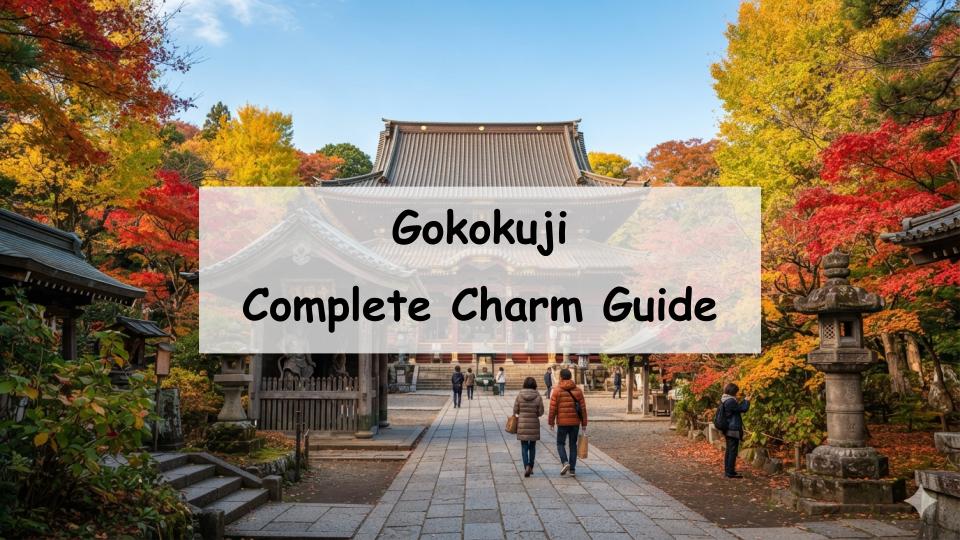
The “Furo-mon,” which stands facing Otowa Street, can be called the face of Gokokuji Temple. This is also called the Niomon (Deva Gate), and Kongorikishi (Vajrapani) statues are enshrined on the left and right. This gate is said to have been originally relocated from another location, a building associated with Tokugawa Ieyasu, and has a profound structure and an overwhelming presence. Once you pass through the gate, a quiet space removed from the secular world spreads out beyond. It is photographed by many as a symbolic landscape of Gokokuji Temple.
One of the Largest Wooden Structures in Tokyo: The “Hondo” (Kannon-do)
Passing through the Furo-mon and proceeding along the stone-paved approach, the magnificent “Hondo” (Kannon-do) appears directly in front. Established in the 10th year of Genroku (1697), this building is known as one of the largest wooden structures in Tokyo and is designated as a National Important Cultural Property. It was built at the request of Keishoin and conveys the advanced architectural techniques of the time to the present day. The vermilion pillars and tiled roof are beautiful, and the secret Buddha, Nyoirin Kannon, is enshrined inside. The time spent quietly putting your hands together in the solemn atmosphere will be a special experience.
Groups of Buildings Designated as Important Cultural Properties
On the grounds of Gokokuji Temple, many historic buildings remain other than the main hall, and many of them are designated as National Important Cultural Properties.
The Tahoto (Two-Storied Pagoda)
The “Tahoto” stands on a slightly elevated spot to the right rear of the main hall. It is a beautiful two-storied pagoda with a roof covered in hiwadabuki (cypress bark), conveying the architectural style of the early Edo period. Its figure, harmonizing with the surrounding greenery, is very picturesque and popular as a hidden photo spot.
The Gekkoden (Former Palace of the Prince of Nikko Rinnoji)
On the east side of the grounds, there is a building called “Gekkoden.” This was originally a palace where the Prince of Nikko Rinnoji lived, and it was relocated here during the Meiji era. It is an elegant shoin-zukuri style building, and the wall paintings and ranma (transoms) inside are also magnificent. It is sometimes open to the public for special viewings, during which time it is bustling with many history fans.
A Vast Cemetery Where Famous People Also Rest and Traces of History
The grounds of Gokokuji Temple are extremely large, and most of it is a cemetery. It is known that many famous people are resting in this cemetery. Graves of historical figures who supported Japan’s modernization, such as politicians, business people, scholars, and cultural figures, are scattered throughout, making it popular as a place for historical walks. The vast site also has a lot of greenery, and walking paths are maintained, so you can walk in a quiet environment while feeling the breath of history.
Annual Events and Seasonal Landscapes of Gokokuji Temple
At Gokokuji Temple, various events are held throughout the year, showing different expressions depending on the season. Why not enjoy the events and the appearance of the grounds according to the timing of your visit?
The Monthly Fair: “Gokokuji Antique Market”
Famous as a monthly regular event at Gokokuji Temple is the “Antique Market.” It is held on the second Sunday of every month on the temple grounds, and is bustling with many antique dealers and enthusiasts. With a wide variety of items lined up, such as old ceramics, vintage clothing, antiques, and miscellaneous goods, there is the fun of searching for bargains. It is a good idea to visit not only for worship but also to match such events. Since many food stalls also appear, it is also fun to stroll through the grounds while eating and walking.
Seasonal Scenery of Cherry Blossoms and Autumn Leaves
The grounds of Gokokuji Temple are rich in nature, and you can enjoy beautiful scenery every season. In spring, cherry blossoms bloom all over the temple grounds and along the approach, and are crowded with many cherry blossom viewers. In particular, the scenery of cherry blossoms blooming with the main hall in the background is one of the most beautiful in Tokyo. In autumn, the autumn leaves are at their best, and the grounds are colored in red and yellow. Strolling through the quiet grounds while looking at the changing trees is a peaceful moment. Also, it shows different faces depending on the season, such as the fresh green season and snowy scenery.
Goshuin (Red Seal Stamps) and Votive Items of Gokokuji Temple
One of the pleasures of visiting shrines and temples is the goshuin, amulets, and other votive items. We introduce special goshuin unique to Gokokuji Temple and attractive votive items.
Types of Goshuin Available at Gokokuji and Reception Location
At Gokokuji Temple, you can receive several types of goshuin. The general one is the goshuin of the principal image, “Nyoirin Kannon.” In addition, goshuin for the Yakushido, a sub-temple on the grounds, and seasonal limited goshuin may also be available. Goshuin are accepted at the temple office (nokyo-sho) on the left side of the main hall. As a souvenir of your visit, why not receive one?
Introduction of Attractive Amulets and Ema (Votive Tablets)
At the temple office, not only goshuin but also various amulets and ema are bestowed. Especially because it is worshipped as a guardian deity of women, popular cute amulets for women, and amulets for good matchmaking and safe childbirth are substantial. Also, there is an ema with the figure of Nyoirin Kannon drawn on it, where you can write your wishes and dedicate them. In addition, amulets for various blessings such as traffic safety and longevity are available, so they are recommended not only for yourself but also as souvenirs.
Access to Gokokuji Temple and Worship Information
Gokokuji Temple is located in the heart of Tokyo and has very good transportation access. We introduce how to get there from the nearest station and basic information regarding worship.
Access from the Nearest Station (How to Go by Train)
The train is the most convenient way to get to Gokokuji Temple. The nearest station is “Gokokuji Station” on the Tokyo Metro Yurakucho Line. The entrance to Gokokuji Temple is immediately in front of you as you exit the station (Exit 1 or Exit 4), and you can arrive without getting lost. Access from the city center is also good, and it can be reached in about 5 minutes from Ikebukuro Station and about 15 minutes from Yurakucho Station. Good access is one of the reasons why many worshippers visit.
Parking Information and Access by Car
If you go to Gokokuji Temple by car, a dedicated parking lot is fully equipped. You can enter from the entrance along Otowa Street and park in a designated place on the grounds. However, congestion is expected during events and holidays, so the use of public transportation is recommended. There are several coin-operated parking lots in the surrounding area, but caution is necessary as the number of parking spaces is limited. When considering access by car, it is safe to check the status of the parking lot in advance.
Regarding Worship Hours and Worship Fees
Worship of the grounds of Gokokuji Temple is basically free. It is open from early morning to evening, and you can stroll freely. However, worship inside specific buildings such as the main hall and Gekkoden, and when receiving prayers, worship fees or prayer fees may be required. Regarding specific worship hours and worship fees, it is recommended to check on the official website in advance. Please note that the reception hours for goshuin also conform to the hours of the temple office.
Recommended Tourist Spots Around Gokokuji Temple
Attractive tourist spots and strolling areas are scattered around Gokokuji Temple. If you are visiting Gokokuji Temple, why not also tour the surrounding area?
Surrounding Areas You Want to Enjoy Strolling
The area around Gokokuji Temple is a calm area dotted with lush parks and historic buildings. Nearby, there is the “Mejiro Garden,” one of the best Japanese gardens in Tokyo, where you can enjoy beautiful nature throughout the seasons. Also, if you go a little further, there is the “Zoshigaya” area, which is associated with literary figures, where you can stroll through retro streets and the Kishimojindo Temple. Furthermore, the popular tourist destination “Ikebukuro” is also nearby, where you can enjoy shopping and gourmet food.
Tokyo History Spot Course Visiting Gokokuji Temple
A course visiting historical spots around Gokokuji Temple is also recommended. For example, starting from Gokokuji Temple, passing through Zoshigaya Kishimojindo Temple, and going towards Ikebukuro is popular as a strolling course where you can feel the history and modernity of Tokyo. Also, although it is a little far, you can feel the history of Edo more deeply by visiting together with “Ueno Onshi Park” and “Senso-ji Temple,” which are also associated with the Tokugawa family. Please plan an original strolling course according to your interests.
A Message from the Guide
I am very interested in the Nyoirin Kannon statue, which is a hidden Buddha (hibutsu). I understand it can be viewed on the 18th of every month, so I plan to aim for that day for my next visit.
Comment